



Colorado has embraced electric bikes faster than many other states, thanks to its strong cycling culture and expansive trail systems. But the state’s regulations aren’t identical to those found elsewhere. Colorado combines statewide rules with strong local authority, which means understanding the basics — and then checking regional guidelines — is essential for every rider.
If you ride in Denver, Boulder, Fort Collins, Colorado Springs, or mountain regions, here’s how the law applies today.
Are ebikes allowed in Colorado?
Yes. Colorado legally recognizes electric bikes and places them under bicycle regulations as long as the bike fits the state’s class system and motor limit. Ebikes do not fall under motorcycle or moped laws and are not treated as motor vehicles.
However, Colorado is unique because it grants local control over trail access. This means a bike that is legal on pavement statewide may be restricted on dirt or natural-surface trails depending on the county or land manager.
Colorado ebike laws at a glance
If you're looking for a quick overview, here's what Colorado law says about electric bicycles.
| Requirement | Colorado Law |
|---|---|
| Driver's License | ❌ Not required |
| Registration | ❌ Not required |
| Vehicle Title | ❌ Not required |
| Insurance | ❌ Not required |
| Helmet | Required for riders under 18 on Class 3 ebikes |
| Minimum Age | 16 years old for Class 3 riders |
| Legal Classes | Class 1, Class 2, Class 3 |
| Maximum Motor Power | 750 watts |
| Maximum Assisted Speed | 20 mph (Class 1 & 2), 28 mph (Class 3) |
Colorado generally treats qualifying electric bicycles the same as traditional bicycles. However, trail access is often determined by local governments and land managers, making Colorado one of the few states where riding rules can vary significantly between cities, counties, parks, and open-space systems.
How colorado defines eike classes
Colorado uses the familiar three-class ebike system, but the way cities enforce them can differ:
- Class 1: These electric bicycles have electric motors that can’t exceed 20 miles per hour (mph). They have pedal assist, meaning the motor can power you forward when you’re pedaling, but they don’t have throttle assist (a mechanism that drives the bike forward even when you aren’t pedaling).
- Class 2: Class 2 ebikes have motors that don’t allow speeds of more than 20 mph. However, Class 2 ebikes have throttle assist and can move forward even if you aren’t pedaling.
- Class 3: Class 3 ebikes are faster and can reach speeds of 28 mph. Colorado law requires Class 3 ebikes to have a speedometer. Additionally, a Class 3 ebike can’t have throttle assist.
All ebikes must stay within the 750-watt motor limit to qualify as bikes under Colorado law.
The class label matters because it determines what kind of trail or pathway you’re allowed to enter — and that varies widely by city.

What is legally considered an electric bicycle in Colorado?
Before looking at where you can ride, it's important to understand how Colorado law defines an electric bicycle.
Under Colorado law, an electric bicycle must:
- Have fully operable pedals.
- Be equipped with an electric motor rated at no more than 750 watts.
- Fall within the state's Class 1, Class 2, or Class 3 ebike system.
- Display a manufacturer label indicating its class, top assisted speed, and motor wattage.
Only bicycles that meet these requirements are legally treated as electric bicycles. Vehicles that exceed these limits may instead fall under different vehicle classifications and be subject to additional operating requirements.
Electric bicycle vs. motorized vehicle
Not every electric two-wheeled vehicle is legally considered an ebike in Colorado. To qualify as an electric bicycle, a vehicle must meet Colorado's legal definition, including the 750-watt motor limit and the state's three-class system.
Higher-powered electric vehicles—or those without fully operable pedals—may instead be classified as mopeds, motorcycles, or other motor vehicles. Those vehicles are subject to different licensing, registration, insurance, and operating requirements.
| Electric Bicycle | Motorized Vehicle |
|---|---|
| Fully operable pedals | May not have functional pedals |
| Motor rated at 750W or less | May exceed 750W |
| Falls within Class 1, 2, or 3 | Outside the three-class system |
| Generally treated as a bicycle | May be regulated as a motor vehicle |
As electric motorcycles and high-powered off-road e-motos become more common, understanding this distinction helps riders choose a vehicle that matches both their riding needs and Colorado law.
Colorado ebike laws
Cyclists with Class 1 and Class 2 ebikes are allowed on regular bike paths and pedestrian lanes. However, ebike riders with Class 3 ebikes aren’t allowed on bicycle or pedestrian paths (unless a local jurisdiction allows otherwise or the path is part of a highway or street).
1. Where can you ride an ebike in Colorado?
Colorado offers excellent riding opportunities, but access depends on both state law and local regulations. Here's a quick overview.
| Location | Are ebikes allowed? |
|---|---|
| Public roads | ✅ Yes |
| Bike lanes | ✅ Yes |
| Road shoulders | ✅ Yes |
| Shared-use paths | ✅ Class 1 & 2 generally allowed |
| Sidewalks | ⚠️ Depends on local ordinances |
| State Parks | ⚠️ Depends on park regulations |
| National Parks | ⚠️ Only where bicycles are permitted |
| National Forests | ⚠️ Depends on the managing agency and trail designation |
| Natural-surface trails | ⚠️ Varies by county or land manager |
Colorado gives significant authority to local governments and public land managers to determine where electric bicycles may operate. Before riding on unfamiliar trails, always check the rules established by the managing agency.
Rocky Mountain National Park
Rocky Mountain National Park is one of Colorado’s most famous outdoor attractions. You can ride an ebike anywhere in Rocky Mountain National Park where traditional bicycles are allowed – essentially on roads (paved and dirt) and parking areas that are open to motor vehicles, but not on trails, including the East Shore Trail.
Colorado State Parks
Colorado Parks and Wildlife (CPW) generally allows Class 1 and Class 2 ebikes on multi-use trails that are already open to traditional bicycles. Class 3 ebikes, however, are typically limited to paved roads and bike lanes within state parks and are not permitted on natural-surface or multi-use trails. Individual parks may impose additional restrictions beyond this general policy, so it's always a good idea to check the specific park's current regulations, especially if you're riding a Class 3 model.
National Forests
Policies within National Forests vary depending on the specific forest, trail designation, and managing office. Some roads and motorized routes permit ebikes, while many non-motorized trails remain restricted. Because these policies differ by location, checking with the local U.S. Forest Service office before your trip is recommended.
2. How old do you have to be to ride an ebike in Colorado?
You must be at least 16 to ride a Class 3 ebike in Colorado. That said, you don’t need any special driver’s license to ride an ebike (like you would with a car, for example).
3. Do you need a helmet when riding an ebike in Colorado?
If you’re under 18 and riding a Class 3 ebike, you must wear a helmet. Learn more about Colorado’s helmet laws — and find out about other states’ requirements — with our guide.
4. Do you need a license or registration?
No. Colorado does not require a driver’s license, insurance, or registration for ebikes that fall within the Class 1–3 system.
As long as the bike complies with motor wattage and class limits, it is treated the same as a traditional bicycle.

Local ordinances for ebikes in Colorado
We’ve covered some general ebiking guidelines in Colorado. However, rules may vary depending on your location.
Colorado allows significant regional discretion. This means:
- Denver offers some of the most ebike-friendly paved trail access.
- Boulder County limits ebikes on many natural-surface trails.
- Colorado Springs has mixed policies depending on trail type.
- Jefferson County Open Space evaluates ebike access trail-by-trail.
- Mountain towns often restrict ebikes on singletrack to preserve trail conditions.
Because cities and counties are actively updating their e-bike policies, especially on natural-surface and open-space trails, always confirm local rules before you ride.
What you should know before riding your ebike in Colorado
Before you start e-cycling in Colorado, look up the regulations where you want to ride. As you can see from the above guide, the rules vary. Beyond this, follow these best practices for a safe and enjoyable e-biking experience:
- Wear a helmet. Colorado law requires anyone under 18 to wear a helmet on a Class 3 ebike. Riders 18 and over are not legally required to wear one, but it’s still strongly recommended.
- Plan your route. Some bike trails can be more fun than others. Popular options in the Rocky Mountains National Park include the Old Fall River Road and Trail Ridge Road. Check details like elevation, length, and opening times. For example, the two trails mentioned are open from April 1 to Nov. 30.
- Pick the right bike. The type of ebike can make a big difference. For example, if you’re planning to go off-roading in unpaved areas, you probably want a bike with fat tires (find out why).
Discover the great outdoors of Colorado with a Velotric ebike
Colorado riders often switch between city streets, scenic greenways, mountain towns, and gravel roads—all in a single weekend. Choosing an ebike that's comfortable, versatile, and adaptable makes it easier to enjoy every type of ride.
Velotric designs its ebikes with that flexibility in mind.
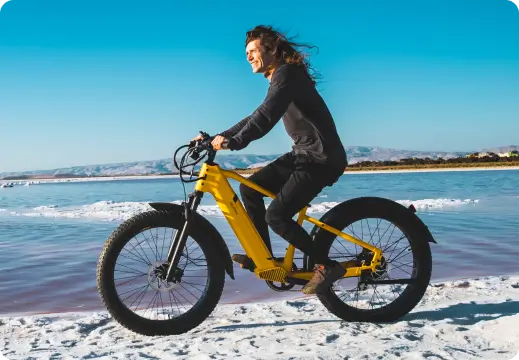
Velotric Discover 3 features One-Touch Class Switching, allowing riders to configure compatible bikes as Class 1, Class 2, or Class 3 where permitted by law. Select models also include a removable throttle, giving riders additional flexibility while helping them comply with local riding regulations.

For commuting through cities like Denver, Boulder, or Fort Collins, the Discover 3 delivers a comfortable upright riding position, long-range performance, and smooth pedal assistance for everyday transportation.
Summary
Colorado provides a clear legal foundation for ebike riders while giving cities and counties room to tailor rules to their landscapes. Pavement access is easy to understand; trail access requires a bit more attention. Once you know the class system and local variations, Colorado is one of the best places in the U.S. to ride an ebike.
Official Resources
The above information is sourced from these websites and was last updated in July 2026. If you have any questions, you can visit the following sites directly for confirmation.
- Colorado General Assembly – Issue brief / summary on electric bicycles and electric scooters (explains classification, paths, and why they are treated as bicycles under state law)
- Colorado Revised Statutes § 42-1-102 – Definitions (including “electrical assisted bicycle” and exclusion from “motor vehicle”)
- Colorado Revised Statutes § 42-4-1412 – Operation of bicycles and electrical assisted bicycles (classes, paths, sidewalks, age & helmet rules for Class 3)
- Rocky Mountain National Park – Biking and e-bike rules (NPS official page)
- Jefferson County Open Space – E-bikes policy
- City of Colorado Springs – E-bikes on City Trails info page