




Electric bikes have become a familiar part of daily transportation in California. Riders use them for commuting, errands, fitness and recreation, but the rules are more detailed than simply staying below a certain speed.
California uses a three-class system that determines how an e-bike may provide assistance, how fast that assistance can continue and which age or helmet rules apply. Access can also change according to the type of bikeway, the trail manager and local ordinances.
This guide explains the California e-bike laws in effect as of August 2026, including the state's latest battery-safety standards, rear-visibility rule, modification restrictions and enforcement provisions.
- What Is an E-Bike in California?
- California's Three E-Bike Classes
- New California E-Bike Laws for 2026
- Where Can You Ride an E-Bike?
- California State Parks Rules
- Age and Helmet Requirements
- License, Registration and Insurance
- Labels, Equipment and Modifications
- California E-Bike Enforcement
- A California-Friendly Commuter E-Bike
What Is an E-Bike in California?
Under California Vehicle Code Section 312.5, an electric bicycle must have fully operable pedals and an electric motor that does not exceed 750 watts. It must also fit one of California's three legal e-bike classes.
A vehicle is not a legal California e-bike if it has no operable pedals, can provide throttle-only assistance above 20 mph, provides pedal assistance above 28 mph or has motor power above the statutory limit. California law also excludes vehicles that are designed to be modified to exceed 20 mph using motor power alone or to exceed 750 watts.
These higher-powered vehicles may instead be treated as mopeds, motorcycles, motor-driven cycles or off-highway vehicles. That can trigger licensing, registration, insurance, equipment and age requirements that do not apply to legal e-bikes.

California's Three E-Bike Classes
The class is based on how the motor operates and when assistance stops. It is not determined only by the speed currently shown on the display.
| Class | Motor Operation | Maximum Assisted Speed | Additional Rules |
|---|---|---|---|
| Class 1 | Pedal assist only | 20 mph | May include start assistance or walk mode up to 3.7 mph. |
| Class 2 | May use a throttle without pedaling | 20 mph | Motor assistance must stop at 20 mph. |
| Class 3 | Pedal assist only | 28 mph | Speedometer required; operator must be at least 16; helmet required for every operator and passenger. |
A Class 1 or Class 3 e-bike may have a low-speed start-assistance or walk-mode function that propels the bicycle without pedaling at up to 3.7 mph. This limited function does not make the bicycle a Class 2 e-bike.
New California E-Bike Laws for 2026
Several California laws took effect or became operative on January 1, 2026. They primarily address battery safety, rear visibility, speed-modification products, sales to minors and enforcement involving illegal high-speed devices.
Battery and Charging Safety Under SB 1271
Senate Bill 1271 established new safety requirements for e-bikes, powered mobility devices, lithium-ion storage batteries and charging systems sold or leased in California.

Beginning January 1, 2026:
- An e-bike may not be distributed, sold, leased or offered for sale or lease unless its storage battery has been tested by an accredited laboratory for compliance with a battery standard referenced in ANSI/CAN/UL 2849, EN 15194 or another standard established by the State Fire Marshal.
- Replacement and conversion-kit batteries must meet the applicable testing requirements.
- A charging system sold or provided for a particular e-bike or battery must be certified for use with that product.
- The applicable laboratory name or mark and certification standard generally must be permanently displayed on the relevant product or electrical system. The statute includes a labeling exception when the product is being rented.
- Manufacturers, importers, distributors and retailers subject to the law must provide a true and accurate laboratory test report when requested.
Separate rental-specific testing requirements become operative on January 1, 2028.
Rear Reflector or Qualifying Rear Light Required at All Times
Under CVC Section 21201, as amended by AB 544, every e-bike must carry one of the following during all hours of operation:
- A red rear reflector; or
- A solid or flashing red rear light with a built-in reflector.
The reflector must meet the statutory 500-foot visibility test. A standard rear light without a built-in reflector does not necessarily replace the required reflector.

This all-hours requirement applies specifically to e-bikes. Conventional bicycles remain subject to the broader lighting and reflector requirements when operated during darkness.
Speed-Modification Apps and Devices
CVC Section 24016 already prohibited selling a product or device that can modify an e-bike's speed capability so that it no longer meets the legal e-bike definition. AB 545 expanded that rule to include software applications beginning in 2026.
A rider may modify an e-bike's speed capability only if the resulting bicycle still meets California's e-bike definition and the required permanent class label is replaced with an accurate label.
Sale of Class 3 E-Bikes to Children Under 16
California already prohibited anyone under 16 from operating a Class 3 e-bike. AB 965 now also prohibits selling a Class 3 e-bike to a person under 16. A violation is an infraction punishable by a fine of up to $250.
New Vehicle Removal Authority
AB 875 authorizes law enforcement to remove certain vehicles in two important situations:
- A Class 3 e-bike is being operated by a person under 16; or
- A vehicle with fewer than four wheels does not qualify as an e-bike, can propel itself above 20 mph using motor power alone and is being operated by someone without the required license.
A removed vehicle generally must be held for at least 48 hours before release, and the agency may require payment of authorized removal and storage costs. In a case involving an underage Class 3 operator, completion of an approved e-bike or local bicycle safety course may also be required.
Where Can You Ride an E-Bike in California?
California generally treats legal e-bikes like conventional bicycles, but access depends on the route type and the public agency or property owner responsible for it.
Roads, Streets and On-Road Bike Lanes
Class 1, Class 2 and Class 3 e-bikes may generally use roads and bicycle lanes where conventional bicycles are allowed. Riders must follow bicycle traffic laws, including traffic signals, lane-direction rules and right-of-way requirements.
Bicycle access may be prohibited on a freeway, expressway or toll facility when the responsible authority has posted a lawful restriction.
Off-Street Bike Paths and Bikeways
California no longer has a blanket statewide rule prohibiting Class 3 e-bikes from bicycle paths, bikeways or bicycle lanes. AB 1909 removed that statewide Class 3 restriction beginning in 2023.
The frequently quoted rule limiting use to paths "within or adjacent to a roadway" now applies to motorized bicycles or mopeds, not to vehicles that qualify as electric bicycles under CVC Section 312.5.
This does not mean every e-bike is permitted on every off-street route. Trail type, local ordinances, public-agency rules, park orders and posted closures can still control access.
Hiking, Equestrian and Recreational Trails
Under CVC Section 21207.5, the local authority or public agency responsible for an equestrian, hiking or recreational trail may prohibit any e-bike class on that trail.
Look for an express e-bike prohibition, a class-specific restriction or a current managing-agency order. A sign that only says "No Motorized Vehicles" should not automatically be interpreted as a statewide e-bike ban because a legal e-bike is not a motor vehicle under CVC Section 24016. The managing authority may, however, separately define or prohibit e-bike use.
Sidewalks
California does not have one statewide sidewalk rule for every city. Local governments regulate bicycle and e-bike operation on sidewalks. Some prohibit riding in commercial districts or designated areas, while others allow it when the rider yields and operates safely.
Do not rely on a general statement that a particular California city bans all sidewalk riding. Check the current municipal code and posted signs for the specific location.
Federal Land
National parks, national forests, Bureau of Land Management property and other federal lands can apply their own e-bike rules. California's state classification system does not automatically establish trail access on federal property.
California State Parks E-Bike Rules
California State Parks applies a more location-specific policy than the general Vehicle Code. E-bikes are allowed on public roadways inside park units, but trail and controlled-access road use normally requires a park-specific Superintendent's Order.
- Public roadways: Class 1, Class 2 and Class 3 e-bikes may be used where conventional bicycles and street-legal vehicles are permitted.
- State Recreation Areas: A Superintendent's Order may allow Class 1 e-bikes on trails and controlled-access roads already open to conventional bicycles. Class 2 and Class 3 are not allowed on these nonpublic routes.
- State Vehicular Recreation Areas: A Superintendent's Order may allow Class 1, Class 2 and Class 3 e-bikes on designated trails and controlled-access roads.
- Other state park classifications: Class 1 e-bikes may be temporarily allowed for approved research or demonstration purposes through a Superintendent's Order. Class 2 and Class 3 are not allowed on nonpublic trails and controlled-access roads.
- Paved commuter trails: State Parks may designate e-bike access on certain paved local or regional commuting trails when consistent with adjoining trail rules.
Park orders are updated individually, so riders should review the specific park page and posted Superintendent's Order before arriving.
Age and Helmet Requirements
California's age and helmet rules depend on the e-bike class and where the bicycle is being operated.
- Class 1 and Class 2: California has no general statewide minimum operator age. A limited San Diego County pilot allows participating local governments to create an under-12 restriction.
- Class 3: The operator must be at least 16 years old.
- Riders and passengers under 18: A properly fitted and fastened ASTM- or CPSC-compliant helmet is required when riding on a street, bikeway or public bicycle path or trail.
- Class 3 operators and passengers: A qualifying helmet is required regardless of age when operating or riding on a street, bikeway or other public bicycle path or trail.

AB 544 also updated the process for resolving certain minor helmet violations involving e-bikes. The CHP-developed specialized e-bike safety course can satisfy the applicable safety-course requirement when the parent or guardian seeks dismissal of the fee under the statutory process.
Do You Need a License, Registration or Insurance?
No. California does not require a driver's license, DMV registration, license plate or motor-vehicle financial responsibility for a bicycle that meets the legal e-bike definition. CVC Section 24016 expressly states that an e-bike is not a motor vehicle for these purposes.
Optional bicycle or e-bike insurance may still provide protection against theft, damage or liability, but it is not a statewide operating requirement.
If a vehicle exceeds the legal power or assistance limits, lacks operable pedals or otherwise falls outside CVC Section 312.5, it may be treated as a moped, motorcycle, motor-driven cycle or off-highway vehicle. The appropriate license, registration, insurance and equipment rules can then apply.
Labels, Equipment and Modifications
Permanent Class Label
Manufacturers and distributors must permanently label each e-bike with its class number, top assisted speed and motor wattage. If a lawful modification changes the bicycle's class, the label must be replaced with one that accurately describes the modified bicycle.
Brakes and Motor Cutoff
An e-bike must comply with applicable bicycle equipment and manufacturing requirements. Its motor must disengage when the brakes are applied, or it must use a control mechanism that stops the motor when the rider releases or activates it.
Night Equipment
During darkness, California requires a white front lamp visible from 300 feet, the applicable rear reflector or qualifying rear lamp, pedal or ankle reflectors and side reflectors or reflectorized tires. The new all-hours rear requirement for e-bikes applies in addition to these nighttime rules.
Speed and Power Modifications
Do not modify an e-bike so that it exceeds California's legal speed or power limits. A software setting, app or aftermarket controller does not make an over-limit vehicle legal. California also prohibits selling products, devices or apps designed to push an e-bike outside the statutory definition.
Local Rules and the San Diego Pilot Program
Cities, counties, school districts, park systems and trail managers may apply location-specific rules within the authority provided by state law. Common variations include sidewalk restrictions, trail closures, park speed limits, school-campus policies and rules for crowded waterfront routes.
California's San Diego Electric Bicycle Safety Pilot Program requires special attention. Until January 1, 2029, a local authority within San Diego County, or the County in its unincorporated areas, may adopt an ordinance prohibiting a person under 12 from operating a Class 1 or Class 2 e-bike.
This is not a statewide under-12 ban. It applies only where an eligible San Diego County jurisdiction has adopted the required ordinance or resolution. The local authority must conduct a public-information campaign before the restriction takes effect. The first 60 days are warning-only; afterward, a violation may carry a $25 fine, subject to the statute's safety-course dismissal procedure.
Before riding in a new area, check:
- The city or county municipal code
- The park or trail manager's official website
- Current maps, posted signs and closure notices
- Any school or campus transportation policy
How California Enforces E-Bike Laws
Depending on the violation, California and local agencies may use warnings, citations, fines, required education or vehicle removal. Enforcement commonly focuses on:
- Underage operation of Class 3 e-bikes
- Helmet violations
- Use on trails expressly closed to e-bikes
- Vehicles modified beyond e-bike speed or power limits
- Illegal throttle assistance above 20 mph
- Missing class labels or required safety equipment
- Devices marketed as e-bikes that are legally mopeds, motorcycles or eMotos
California's Attorney General has emphasized that a two-wheeled vehicle providing pedal assistance above 28 mph or throttle assistance above 20 mph is not a legal e-bike. Buyers should check the permanent label and actual specifications instead of relying only on the product name or its appearance.
Tips for California E-Bike Riders
- Identify the class before riding: Check the permanent label, motor operation and assisted-speed limit.
- Confirm trail access: A route open to bicycles is not automatically open to every e-bike class, especially in parks and natural areas.
- Carry the required rear equipment: Use a compliant red reflector or a qualifying rear lamp with a built-in reflector during every ride.
- Use complete nighttime equipment: Add the required front lamp, pedal or ankle reflectors and side visibility equipment after dark.
- Keep the legal configuration: Do not use apps, controllers or settings that push assistance beyond California's limits.
- Slow down around other users: Yield to pedestrians and use a safe speed on crowded paths, sidewalks where permitted and blind trail sections.
- Maintain the bicycle: Regularly inspect the brakes, tires, lights, battery, connectors and charging system. Review this e-bike maintenance checklist.
A California-Friendly Commuter E-Bike: Velotric Discover 3
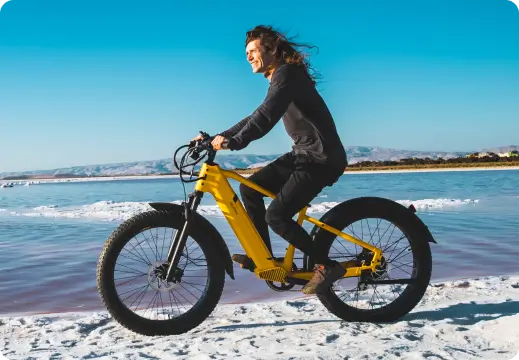
For California riders looking for a comfortable commuter e-bike, the Velotric Discover 3 combines a 750-watt rated motor, long-range battery, hydraulic disc brakes and integrated visibility features.

Certified Electrical Safety
Discover 3 is listed as certified to UL 2849 for its electrical system and UL 2271 for its battery. These certifications support California's focus on tested batteries and electrical systems under SB 1271.
Visibility and Braking
The bike includes a 500-lumen front light, a rear light with steady and flashing modes, brake indication and turn signals. California riders should also confirm that the bicycle has either a compliant red rear reflector or a rear light with the built-in reflector required by CVC Section 21201.
Comfort and Everyday Range
A low step-through frame, upright riding position, suspension seatpost, air-suspension fork and ergonomic saddle support daily commuting and longer recreational rides. Discover 3 offers a claimed pedal-assist range of up to 80 miles, although actual range varies with rider weight, terrain, weather, assistance level and riding speed.
Connected Riding Features

- SensorSwap lets riders switch between torque and cadence sensing.
- Ride Tuning adjusts motor response and assistance preferences.
- Apple Find My and Google's Find Hub provide compatible tracking options.
- NFC Unlock offers convenient access without a conventional key.
Final Thoughts
California remains broadly accessible to legal Class 1, Class 2 and Class 3 e-bikes, particularly on roads and bikeways where conventional bicycles are permitted. The main complications arise on recreational trails, state park property, sidewalks and routes controlled by local agencies.
For 2026, riders should pay particular attention to the all-hours rear reflector requirement, battery and charger certification rules, speed-modification restrictions and expanded enforcement involving underage Class 3 riders and high-speed vehicles incorrectly marketed as e-bikes.
The safest approach is simple: confirm that the bicycle meets California's legal definition, know its class, keep the required equipment installed and review the current rule for every unfamiliar trail or park.
Official Data Sources
This guide is for informational purposes only and does not constitute legal advice. It reflects California law and published agency guidance as of August 2026. State legislation, local ordinances, park orders and trail rules can change. Confirm the current requirements with the California Legislature, CHP and the authority responsible for your route before riding.
- California Vehicle Code Section 312.5
- California Vehicle Code Section 21201
- California Vehicle Code Section 21207.5
- California Vehicle Code Section 21212
- California Vehicle Code Section 21213
- California Vehicle Code Section 24016
- California Senate Bill 1271
- California Assembly Bill 544
- California Assembly Bill 545
- California Assembly Bill 875
- California Assembly Bill 965
- California Assembly Bill 2234
- California Highway Patrol, 2026 Public Safety Laws
- California State Parks, E-Bikes in State Parks
- California Attorney General, E-Bike Safety and Legal Requirements