








Last Updated: January 2026
This state-by-state ebike law guide includes the most recent updates through 2026, reflecting changes to Class 3 trail access, helmet laws, and registration requirements.
Electric bikes continue to rise in popularity as a fun, convenient, and green option for motorized travel. As more ebikes hit the road, new state laws are written to ensure safe travel for everyone. However, electric bike laws can be tricky to keep up with as they vary from state to state.
We gathered statistics from all 50 states and researched how lawmakers across the nation are defining ebikes. In this article, we will discuss our findings and share a comprehensive compilation of ebike laws from around the country.
- What is an electric bike?
- 2026 Electric Bike Law Updates (Summary)
- Do I need a license for an ebike?
- What is the age requirement to operate an electric bicycle?
- Do I need to register my electric bike?
- Do I have to wear a helmet on an ebike?
- Can I ride my ebike on the sidewalk?
- Ride safely and comfortably with Velotric Electric Bike
What is an electric bike?
As ebikes are relatively new and come in different varieties, there is no standard definition of electric bikes. With various types of motors and multiple levels of pedal assistance, ebikes are often defined by law with a three-class system.

- Class 1: A motorized bicycle that only provides assistance when the ebike rider is pedaling and has a maximum assisted speed of 20 mph
- Class 2: A throttle-assisted motorized bicycle with a maximum assisted speed of 20 mph
- Class 3: A motorized bicycle that only provides assistance when the ebike rider is pedaling and has a maximum assisted speed of 28 mph
Classification laws tell cyclists what they can ride and where. These guidelines vary from state to state, so be sure to check your local ordinances before purchasing an ebike and taking it for a spin. Does your state use a three-class system or not? Let’s see.
2026 Electric Bike Law Updates (Summary)
As of 2026, there is no nationwide federal overhaul of electric bike laws in the United States. Regulatory changes continue to occur primarily at the state and local level. Most states still follow the established three-class ebike framework (Class 1 / 2 / 3), but several states have introduced notable updates focused on safety, compliance, and regulation.
California
- New required equipment and visibility rules: Electric bicycles must now be equipped with a rear red reflector or a solid/flashing red rear light with a built-in reflector at all times, not just at night. The update improves daytime visibility and rider safety.
- Mandatory battery and electrical safety certifications (SB 1271): All new e-bikes sold or leased in California must be tested by an accredited laboratory and comply with recognized safety standards such as UL 2849 or equivalent. Uncertified batteries or electrical systems may not be sold, and compliant products must carry clear certification labels.
- Clearer ebike classification and speed rules: The Class 1 / 2 / 3 system remains in place, with added clarification that Class 1 and Class 3 ebikes must be pedal-assist only (no throttle beyond walking speed) and properly labeled to reflect their classification.
- Increased parental responsibility for minors: Parents or guardians may be cited or fined if minors operate e-bikes without required safety equipment or ride non-compliant e-bikes.
- Age limits and sales restrictions remain in force: Riders under 16 years old are prohibited from operating Class 3 e-bikes, and selling Class 3 e-bikes to minors can result in fines of up to approximately $250.
New Jersey
-
Licensing requirements: All electric bicycles have been reclassified as “motorized bicycles.” Riders must hold a specific license to operate them legally.
Riders with a standard driver’s license are exempt from additional licensing, while others must:
Be at least 15 years old
Complete ID verification
Pass vision, written, and road tests
- Vehicle registration and insurance requirements: Electric bicycles must be registered and covered by insurance, significantly increasing compliance obligations for riders.
- Elimination of the three-class system: The traditional Class 1 / Class 2 / Class 3 e-bike framework has been abolished, with all e-bikes now regulated uniformly as motorized bicycles.
Note: This summary reflects the latest regulatory updates through January 2026. Detailed information is included under each state below.

*Note: New Jersey reclassified e-bikes as motorized bicycles in 2026 and no longer follows the three-class system.
36 states and the District of Columbia use the three-class system for ebike classification: Alabama, Arizona, Arkansas, California, Colorado, Connecticut, Delaware, Florida, Georgia, Idaho, Illinois, Indiana, Iowa, Louisiana, Maine, Maryland, Michigan, Minnesota, Mississippi, Missouri, Nevada, New Hampshire New York, North Dakota, Ohio, Oklahoma, Oregon, South Dakota, Tennessee, Texas, Utah, Vermont, Virginia, Washington, West Virginia, Wisconsin, and Wyoming.
The fourteen states who don’t use the three-class system define electric bikes as follows:
- Alaska: A motor-driven cycle
- Hawaii: A low-speed electric bicycle as detailed in 15 U.S. Code § 2085
- Kansas: An electric-assisted bicycle with two or three wheels, a seat, fully operative pedals, and an electric motor; The electric motor must have a power output of no more than 1,000 watts and not propel or assist over 20 mph on level ground.
- Kentucky: A bicycle must have operable pedals.
- Massachusetts: A motorized bicycle (either a pedal bicycle with a helper motor or a non-pedal bicycle with a motor) with a maximum cylinder capacity of 50 cubic centimeters, an automatic transmission, and a maximum speed of 30 mph on level ground
- Montana: An ebike or electrically assisted bicycle with two operational pedals and an attached motor that propels the bicycle and a 170-pound rider no faster than 20 mph on level ground
- Nebraska: A bicycle with two or three wheels, fully operative pedals, and an electric motor with a maximum capacity of 750 watts that can propel the bicycle at a maximum speed of 20 mph on level ground
- New Jersey: Has passed a 2026 law that effectively abolished the three-tier classification system by reclassifying all e-bikes as motorized bicycles with licensing, registration and insurance requirements.
- New Mexico: A moped with two or three wheels, an automatic transmission, and a motor having a piston displacement of less than 50 cubic centimeters with a maximum speed of 30 mph on level ground
- North Carolina: An electric-assisted bicycle with two or three wheels, a seat, fully operable pedals, and an electric motor of no more than 750 watts with a maximum speed of 20 mph on a level surface
- Pennsylvania: A pedalcycle with electric assist weighing a maximum of 100 pounds with two or three wheels larger than 11 inches in diameter, operable pedals, and an electric motor of no more than 750 watts and a maximum speed of 20 mph on a level surface
- Rhode Island: An electric motorized bike propelled by human power or electric motor power, or both, with an electric motor no more than 2 horsepower and a maximum speed of 25 mph on level ground
- South Carolina: An electric assist bicycle or bicycle with a helper motor and two or three wheels, operable pedals, and an electric motor of no more than 750 watts; maximum motor-powered speed of 20 mph when operated on a paved level surface by a rider weighing 170 pounds; the electric motor must disengage or cease to function when the brakes are applied or the rider stops pedalin. Electric assist bicycles are not mopeds.
Do I need a license for an ebike?
Most states do not require a driver’s license to operate an ebike, but a handful do. However, many state and local authorities are only beginning to write electric bicycle laws into their vehicle codes. As such, you should always check with your local department of motor vehicles before riding your ebike.

States that require an operator’s license to operate an electric bicycle:
- Alabama
- Alaska
- Connecticut
- Hawaii
- Louisiana
- Massachusetts
- Missouri
- New Jersey
- New Mexico
- North Dakota
- West Virginia
What is the age requirement to operate an electric bicycle?
Each state has different ebike age requirements, and some don’t have any age requirements at all. As many ebike laws are still being legislated, check with your local department of motor vehicles before heading out on the roadways.
States with a minimum age requirement of 14 for ebikes:
- Alabama
- Alaska
- Michigan
- North Dakota
- Tennessee
- Utah
- Virginia
States with a minimum age requirement of 15 for electric bicycles:
- Georgia
- Hawaii
- Idaho
- Indiana
- Louisiana
- Minnesota
- New Jersey
- New Mexico
- Oregon
- Texas
- Washington
- West Virginia
States with a minimum age requirement of 16 for electric bikes:
- Arkansas
- California (Class 3 only)
- Colorado
- Connecticut
- Delaware
- Illinois
- Maine
- Massachusetts
- Maryland
- Missouri
- New Hampshire
- New York
- North Carolina
- Ohio
- Oklahoma
- Pennsylvania
- South Dakota
- Vermont
- Wisconsin
States with a minimum age requirement of 18 for ebikes:
- South Carolina
States with no age requirement for electric bicycles:
- Arizona
- Florida (no single statewide minimum age; local governments may set age/ID rules)
- Iowa
- Kansas
- Kentucky
- Mississippi
- Montana
- Nebraska
- Nevada
- Rhode Island
- Wyoming
Do I need to register my electric bike?
Most states do not require ebike riders to register their electric bicycle, but some do. Again, ebike laws continue to be updated, so always check with local authorities before pedaling into the bike lanes.

States that require ebike registration:
- Alabama
- Alaska
- Hawaii
- Louisiana
- Massachusetts
- New Jersey
- New Mexico
- North Dakota
- West Virginia
Note: Registration and insurance rules can differ by class.
Do I have to wear a helmet on an ebike?
Before addressing the laws of helmet wearing, we firmly believe you should always wear a helmet when riding any bicycle, moped, or scooter. Wearing a helmet while riding an ebike is especially important if you plan on cycling on the roadways with motor vehicles — in the case of an accident, a helmet can save your life. Even on bike paths, helmets are essential to protect ebike riders from accidents caused by bumpy pathways or inattentive riders.
As for state laws and legal rules of the road, things vary from state to state. A little over half of U.S. states require ebike riders to wear a helmet at least sometimes, and about a dozen require it all the time.
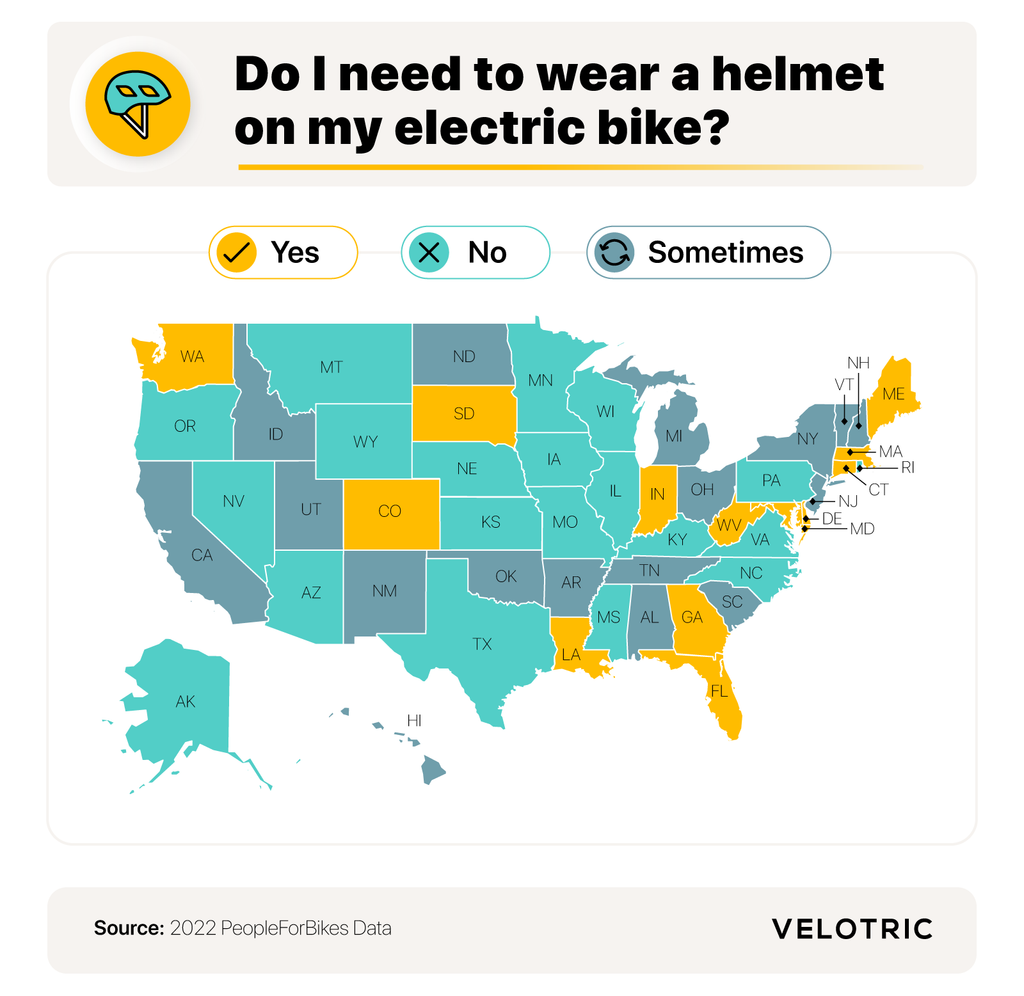
States that ALWAYS require a helmet when riding an electric bicycle:
- Colorado
- Connecticut
- Delaware
- Georgia
- Indiana
- Louisiana
- Maine
- Maryland
- Massachusetts
- New Jersey
- South Dakota
- Washington
- West Virginia
States that SOMETIMES require a helmet when riding an electric bicycle:
- Alabama
- Arkansas
- California (Class 3 riders; and riders under 18 for Class 1–2)
- Florida (riders/passengers under 16)
- Hawaii
- Idaho
- Michigan
- New Hampshire
- New Mexico
- New York
- North Dakota
- Ohio
- Oklahoma
- South Carolina
- Tennessee
- Utah
- Vermont
Refer to your local bicycle laws for specifics on when and where you must wear a helmet.
States that DO NOT require a helmet when riding an ebike:
- Alaska
- Arizona
- Illinois
- Iowa
- Kansas
- Kentucky
- Minnesota
- Mississippi
- Missouri
- Montana
- Nebraska
- Nevada
- North Carolina
- Oregon
- Pennsylvania
- Rhode Island
- Texas
- Virginia
- Wisconsin
- Wyoming
Can I ride my ebike on the sidewalk?
Most states do not let ebikes on the sidewalk, but a handful allow it. As always, check your local ebike laws for the most current regulations, and when in doubt, stick to the bike paths as the safest routes.
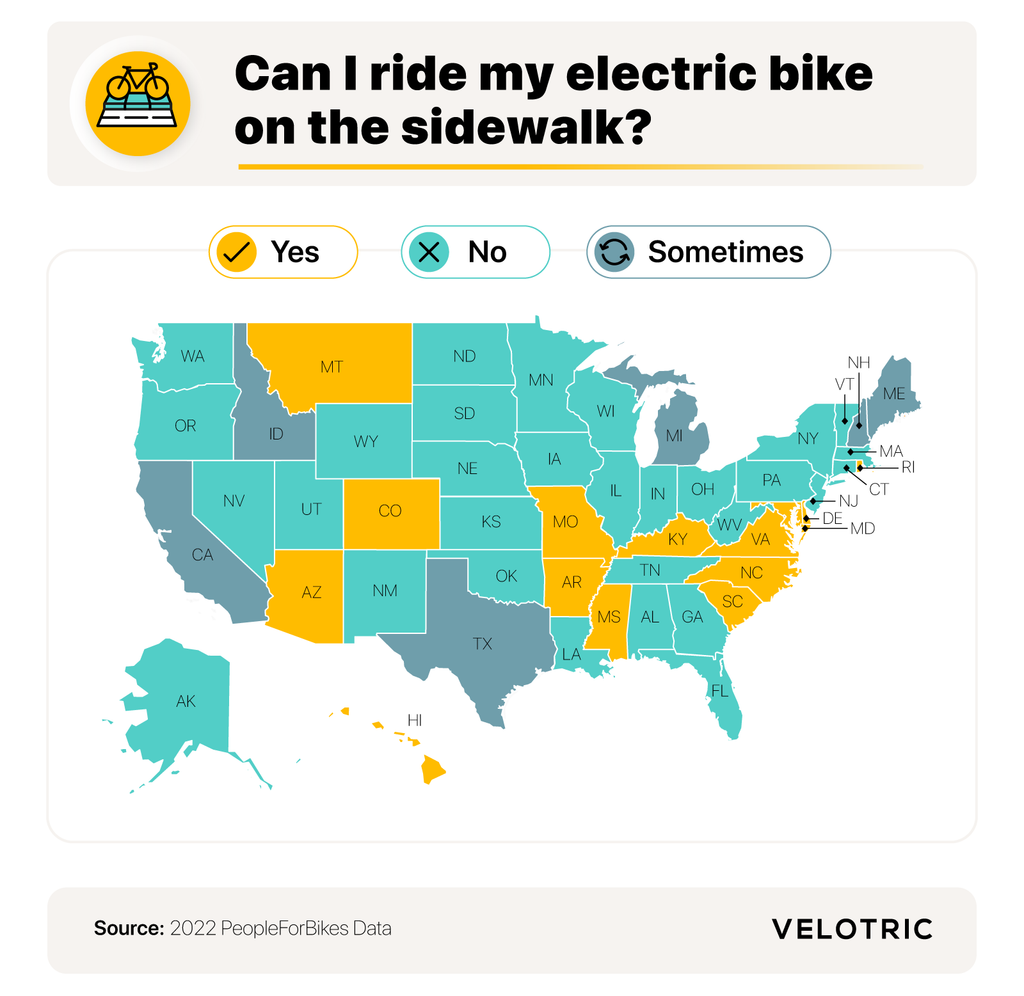
States where you CAN ride your ebike on the sidewalk:
- Arizona
- Arkansas
- Colorado
- Delaware
- Hawaii
- Kentucky
- Maryland
- Mississippi
- Missouri
- Montana
- North Carolina
- Rhode Island
- South Carolina
- Virginia
States where you can SOMETIMES ride your ebike on the sidewalk:
- California
- Florida
- Idaho
- Maine
- Michigan
- New Hampshire
- Texas
Refer to local bicycle laws for specifics on when and where you may bike on the sidewalk.
States where you CANNOT ride your electric bicycle on the sidewalk:
- Alabama
- Alaska
- Connecticut
- Georgia
- Illinois
- Indiana
- Iowa
- Kansas
- Louisiana
- Massachusetts
- Minnesota
- Nebraska
- Nevada
- New Jersey
- New Mexico
- New York
- North Dakota
- Ohio
- Oklahoma
- Oregon
- Pennsylvania
- South Dakota
- Tennessee
- Utah
- Vermont
- Washington
- West Virginia
- Wisconsin
- Wyoming
Remember to obey all speed limits and traffic lights when riding on roadways, and always use appropriate signals.
Ride safely and comfortably with Velotric Electric Bike
Whether you use your ebike to commute to work or cruise around for fun, it’s imperative to understand the laws governing electric bikes. As ebike laws continue to be written and evolve, ebike riders should stay abreast of changing regulations to ensure compliance. Once you’re confident that you’re legally operating your electric bike, you can breeze down every bicycle path knowing you have nothing to worry about.
We hoped this makes the legality of riding ebikes clearer for you! If you’re looking for a great ride at a great price, we would –of course– recommend our own Velotric ebikes.
Learn more about Velotric Ebikes
Fair Use Statement
Do you have ebike friends in other states who could use this easy-reference law guide? Feel free to share this article with anyone you’d like. We just ask that you do so for noncommercial purposes only and provide a link back to this page to give the authors their due credit.
Note: Ebike laws change frequently at the state and municipal level. This page reflects updates through 2026 based on information from state DOTs and park authorities. Always verify with your local Department of Transportation or State Parks office before riding.
Data Sources
The above information is sourced from these websites and was last updated in January 2026. If you have any questions, you can visit the following sites directly for confirmation.
- Cyclingnews.com: How do electric bikes work?
- Health.choc.org: Are electric bikes (e-bikes) safe for kids? How to prevent injuries
- Peopleforbikes.org: 2022 State Legislative Wins for Electric Bicycles
- NJ.gov: Motorized Bicycle/ATV/Snowmobile/Agricultural
- California Ebike Laws: A 2026 Overview
- NJ Gov. Murphy signs law requiring license to ride all forms of e-bikes


