



For years, city ebikes followed a simple formula: add a motor, add a battery, and make commuting easier. But today's riders are looking for very different things. Some want an ebike that still feels like a traditional bicycle, but others want something smarter.
That difference becomes especially clear when comparing the Velotric Tempo and Trek FX+ 1. Both belong to the lightweight commuter ebike category, but they approach urban riding from completely different directions. So if you're trying to choose between them, the real question is which kind of rider you are. Let's take a closer look.
Velotric Tempo vs Trek FX+ 1: Full Specs Comparison
Check the complete side-by-side spec breakdown below if you want more detailed information.
| Velotric Tempo | Trek FX+ 1 | |
|---|---|---|
| MODEL | ||
| Price | $1,499 | $2,199.99 |
| SIZE GUIDE | ||
| Bike Size | Regular/Large | Small/Medium/Large |
| Type | High-step & Mid-step | High-step & Mid-step |
| User Height Range | High-step: 4'11'' ~ 6'4'' Mid-step: 4'10'' ~ 5'11'' |
High-step: 5'1" - 6'6" Mid-step: 5'1" - 6'1" |
| FRAMESET | ||
| Frame | 6061 Triple-Butted Aluminum Alloy | Alpha Gold Aluminum |
| Fork | 6061 Aluminum Alloy, Internal Brake Routing, 12x100mm Thru-axle | Alloy, internal brake routing, fender mounts, rack mounts, ThruSkew 5mm bolt-on skewer |
| ELECTRONICS | ||
| Motor | 36V, 350W, 650W(Peak Power), 45Nm | 500W, 36H, black, 60 Nm |
| Battery | 36V, 10.4Ah(374Wh), IPX7, Certified by UL2271 | 520Wh, integrated in down tube |
| Cell | Samsung/LG 21700 cell, Certified by UL2580 | Not mentioned |
| Charger | 36V, 2A Fast Charger | Trek Easy Mag charger, 2.7A, 54.9V output, 100V-240V AC input |
| Sensor | Torque and Cadence Sensor | Torque Sensor |
| Display | 2.0" Left-mounted Full-color Display with High Brightness, Bluetooth, NFC | LCD display |
| USB Port | USB Type-C Phone Charge | ✗ |
| Throttle | Trigger-control, Removable | ✓ |
| Pedal Assist | 4 Riding Modes + Pulse Mode™ / Ride Tuning | ✓ |
| Walk Mode | 2.9 MPH / Walk & Hold | ✗ |
| Front Light | 500LM High-output Integrated LED, Adjustable Angle | Herrmans MR8, 180 lumen, 60 lux, LED headlight |
| Rear Light | Brake Highlight, Turn Signal | Integrated brake light and turn signals |
| Water Resistant | IPX6 | Not mentioned |
| OTA | App OTA | ✗ |
| Anti-theft | Apple Find My & Google's Find Hub, NFC Card Unlock | Stay connected with Trek Central App |
| SPEED & RANGE | ||
| Max Speed (Default) | 20MPH | / |
| Max Speed Adjustable Range | 12~28MPH | / |
| E-Bike Class | 1/2/3 | 2/3 |
| Range | 60Miles | Up to 50 miles |
| DRIVETRAIN | ||
| Chainrings | 46T Narrow-Wide Chainring | 40T steel chainring |
| Crankset | Aluminum Alloy, 170mm | Alloy, 170mm length |
| Freewheel | 8-speed,11-40T | Shimano HG400, 11-45, 8 speed |
| Rear Derailleur | SHIMANO 8-speed | Shimano ESSA U2000 |
| Shift Lever | SHIMANO 8-speed | Shimano M315, 8 speed |
| BRAKE | ||
| Brake | SHIMANO Hydraulic Disc Brake | Rush BH-286 hydraulic disc |
| Rotors | 180mm Front and Rear | 180mm rotor |
| Brake Levers | Aluminum Alloy, with Power Cutoff | Not mentioned |
| WHEEL | ||
| Rims | Aluminum Alloy | Alloy double wall, 36h |
| Front Hub | NOVATEC Aluminum Alloy, 12x100mm Thru-axle | Alloy low-flange w/6-bolt disc, 36h, w/QR |
| Tire | KENDA 700×42c eBike Puncture Resistant Gravel | Bontrager GR0 Comp, wire bead, 60 tpi, 650x50mm |
| COCKPIT | ||
| Handlebar | Aluminum Alloy, Φ31.8mm, 660mm | Bontrager alloy, 31.8mm, 15mm rise 690mm width (Size S & M) 720mm width (Size L & XL) |
| Grips | Durable Ergonomic Grips, Lockable | Bontrager XR Endurance Comp, lock-on |
| Stem | Adjustable, Aluminum Alloy, Φ31.8mm, 60mm Length | Bontrager Elite, 31.8mm, Blendr compatible, 7 degree 80mm length (Size S & M) 90mm length (Size L & XL) |
| Saddle | VELOTRIC Ergonomic Seat | Bontrager Sport |
| Seatpost | Aluminum Alloy, Φ30.9mm, 350mm | Bontrager alloy, 31.6mm, 12mm offset 330mm length (Size S & M) 400mm length (Size L & XL) |
| Clamp | Aluminum Alloy, Quick Release | Not mentioned |
| Pedals | Plastic | Bontrager City pedals |
| Kickstand | Aluminum Alloy, Included, Rear Mount | Adjustable length alloy kickstand |
| WEIGHT & LOAD | ||
| Bike Weight | 39 lbs | 48.73 lbs |
| Bike Weight (without battery) | 34 lbs | Not mentioned |
| Max Bike Load Capacity | 330 lbs | 300 lbs |
| CERTIFICATION | ||
| UL Certification | UL2849 & UL2271 | UL2849 |
| ISO Standard | ISO 4210 | Not mentioned |
Weight: The Number That Follows You Everywhere
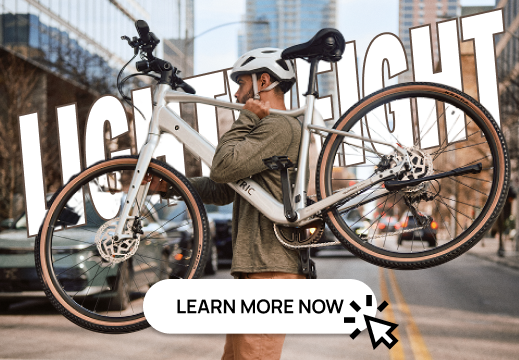
The Tempo weighs 39 lbs, 34 lbs without the battery. The Trek comes in at 48.73 lbs. Weight is one of those specs that compounds. A lighter bike accelerates more easily, handles more naturally at low speeds, and demands less from you every time the motor isn't running. For riders who move their bike through daily life as much as they ride it — through apartment lobbies, office buildings, city corridors — the Tempo's advantage here isn't just a number. It's the texture of ownership over months and years.

The summary: The Tempo's lighter frame changes the everyday ownership experience, especially for riders who lift, store, park, or maneuver their ebike in tight urban spaces.
Smart Features: Two Different Visions of Connectivity
The Trek FX+ 1 connects to the Trek Central app, which handles the basics cleanly and without fuss. If what you want is a capable ebike that stays out of the way, that's a perfectly coherent design choice. The Velotric Tempo has different ambitions. Apple Find My, Google's Find Hub, NFC card unlock, over-the-air firmware updates, USB-C phone charging, and a full-color Bluetooth display are all standard.

The shorthand version: Trek adds assistance to a bicycle. Tempo builds technology around daily riding. Neither framing is a criticism, but they do reflect genuinely different ideas about what an ebike is for. If your phone is already the organizing center of how you navigate, work, and move through the city, the Tempo slots into that life without friction. If you'd rather the bike stay simple and let you focus on the road, Trek's restraint is a feature, not a limitation.
The summary: Trek keeps the experience minimal. Tempo leans into connected daily mobility, with more tools for security, charging, updates, and everyday convenience.
Ride Feel: Consistency vs. Configurability
Both lightweight ebikes use torque sensors. A meaningful detail separates them from cheaper systems where assist kicks in the moment you start pedaling, regardless of effort. Torque sensing makes the ride feel more intuitive, more proportional, more like an extension of your own legs rather than a machine doing something alongside them. On this front, both bikes earn their place.

The Tempo goes further by pairing torque sensing with a cadence sensor, adding Pulse Mode™, Ride Tuning, and four distinct ride modes. The result is a bike you can shape to match your mood, your route, or your energy level on any given day.
Trek, by contrast, offers one carefully tuned experience and executes it with consistency. Riders who want the ebike to feel like a bike, without variables to manage or settings to adjust, will find exactly that here. Riders who want to dial in their setup, experiment with different assist personalities, and genuinely customize how the motor responds will find that the Tempo rewards that curiosity.
The summary: Trek focuses on one clean, natural ride profile. Tempo gives riders more room to tune the ride around route, effort, and daily energy level.
Motor Power: Raw Numbers and What They Actually Mean
Trek's motor specs are stronger on paper: 500W rated, 60Nm of torque, versus the Tempo's 350W rated (650W peak) and 45Nm. In terms of climbing ability and immediate acceleration, that difference is real. And for riders who regularly navigate steep hills or simply want maximum punch on demand, those numbers carry weight.

But torque doesn't operate in a vacuum. The Trek's motor is also moving nearly ten extra pounds of bike, which means some of that power is working against its own frame. A less powerful motor in a lighter ebike can deliver a ride that feels quicker and more responsive than a raw watt comparison suggests.
And in the stop-and-go rhythm of city riding, acceleration out of intersections matters more than sustained climbing power. The Tempo holds its own more than the specs imply. If your commute runs through genuinely hilly terrain, the Trek's advantage is real. If it doesn't, the calculus shifts.
The summary: Trek has the stronger motor numbers. Tempo counters with a lighter platform, responsive city handling, and enough power for everyday urban commuting.
Safety & Weather: What Gets Published Matters
The Tempo carries IPX6 weather resistance — a rating that means it can handle powerful, sustained water jets from any direction, relevant context for anyone who rides in rain or through wet streets. Its certifications include UL2271 for battery safety, UL2849 for the complete ebike system, and ISO 4210 for mechanical bicycle standards.

The Trek lists UL2849 certification; IP rating and ISO status are not disclosed in the available specifications.
This isn't a claim that one bike is safer than the other, both are commercial products that have cleared relevant safety reviews. What differs is the information available to buyers. Tempo publishes a more complete picture of what it's been tested against, and for riders who want to understand their bike's limits before committing, that transparency is genuinely useful. Making a decision with more data is always better than making it with less.
The summary: Tempo gives buyers more published testing context across weather resistance, battery safety, system safety, and mechanical standards.
Lighting: What 500 Lumens Actually Means on a Dark Street
The Tempo runs a 500-lumen front light with adjustable angle, plus a rear brake light and turn signals. The Trek uses a Herrmans MR8 — 180 lumens, with an integrated brake light and turn signals. Both cover the basics of being seen.
But the difference between a light that genuinely illuminates the road ahead and one that signals your presence to other traffic. For riders who commute in the early morning or after dark, who navigate unlit bike paths or rain-soaked streets, that gap shows up every single ride.
The summary: Both bikes support visibility. Tempo's stronger front light is more useful when the goal is not only being seen, but actually seeing the road ahead.
The Small Stuff That Adds Up
Walk mode (motor-assisted pushing at 2.9 MPH) is a useful feature when you're rolling a bike uphill through a parking garage or navigating a crowded platform. USB-C charging can save your nearly dead phone when you're far from home. The removable throttle gives you an option Trek simply doesn't offer.
None of these features will appear in a headline comparison. But they're the details that shape how a bike actually feels to own in daily riding, whether it works with your life or subtly against it.
The summary: Tempo's advantage lives in the small ownership details — the kind that do not always dominate spec sheets, but show up constantly in real commutes.
Who Each Ebike Is Really For
These two bikes are not competing around the margins. They are built around different assumptions of what urban riding should feel like.
Choose the Velotric Tempo if:
- You regularly carry your bike through apartments, offices, elevators, or tight city spaces
- You want a lighter ebike that feels easier to manage off the road
- You want more ride customization through Pulse Mode™, Ride Tuning, and multiple riding modes
- You ride in rain and care about published IPX and certification standards
- You ride after dark and want stronger front lighting performance
- You want the strongest overall value at a lower price
Choose the Trek FX+ 1 if:
- You want a polished, natural bicycle experience with clean electric assistance underneath
- You prefer fewer settings, fewer smart systems, and less tech complexity
- You prefer Trek's established cycling ecosystem
- You value consistency more than customization
- You simply want to pedal without thinking much about connected features
The Bigger Difference Isn't the Spec Sheet
The Trek FX+ 1 is for riders who want a polished, natural bicycle experience with clean electric assistance layered underneath it. At $2,199.99, it's a premium take on a classic approach.
The Tempo is for riders who live in cities, carry their bikes through daily environments, ride in low light. And they may want their ebike to work the way the rest of their technology does — connected, adaptable, and loaded with the small practical features that earn their keep over time. At $1,499, it offers more of that kind of value than anything else in its price range.
Seven hundred dollars separates them. So does a fundamentally different idea of what an ebike is for.