Sales








Last Updated: November 2026
Tennessee offers city bike lanes, greenways and scenic park roads, but ebike access depends on more than the bike's assisted speed. State law, local restrictions and land-manager rules can all affect where you ride.
This guide explains Tennessee ebike laws as of November 5, 2026, including the 2026 changes to Class 3 rider age and local regulatory authority. It also covers helmet requirements, sidewalks, trail access and equipment.
Black Friday Starts Now

- What changed in Tennessee ebike law in 2026?
- Tennessee ebike laws at a glance
- What legally qualifies as an ebike in Tennessee?
- Do you need a license, registration or insurance?
- Where can you ride an ebike in Tennessee?
- State parks, wildlife areas and the Smokies
- Age requirements and helmet laws
- Equipment, labels and modifications
- Penalties and enforcement
- Tips for riding legally in Tennessee
- A lightweight option: Velotric Tempo
- Frequently asked questions
What changed in Tennessee ebike law in 2026?
Senate Bill 1782, enacted as Public Chapter 651, became law on April 1, 2026. Its access-rule amendments took effect that day, while its Class 3 age amendment took effect July 1, 2026.
- Class 3 minimum age increased. A person under 16 may not operate a Class 3 ebike on a street or highway. Older guides that list age 14 are outdated.
- Local authority expanded. Local governments may regulate or prohibit Class 1 and Class 2 ebikes on portions of streets or highways within their jurisdiction, including state highways, when necessary for public safety. State agencies have similar authority over routes under their jurisdiction.
- Class 3 trail access remains conditional. The amended law retains an exception for qualifying routes within or adjacent to a street or highway, and allows the relevant local government or state agency to authorize other routes.
Tennessee ebike laws at a glance
- Motor limit: The statutory ebike definition requires a motor of less than 750 watts.
- Classes: Class 1 and Class 2 assistance cuts off at 20 mph; Class 3 pedal assistance cuts off at 28 mph.
- License, title and registration: Not required under the state's motor-vehicle rules for a qualifying ebike.
- Insurance: A qualifying ebike is not subject to Tennessee's motor-vehicle financial-responsibility requirements.
- Class 3 age: Operators must be at least 16 on streets and highways, effective July 1, 2026.
- Helmets: Required for every Class 3 operator and passenger. The general child bicycle helmet law also applies to riders and passengers under 16 on highways, streets and sidewalks.
- Sidewalks: Local or agency authorization for bicycle use is required, and the electric motor must be disabled.
- Class 3 equipment: A speedometer displaying mph is required for street or highway operation.
What legally qualifies as an ebike in Tennessee?
Under Tennessee Code Annotated (TCA) 55-8-301, an electric bicycle must have fully operable pedals, two or three wheels meeting the statute's 20-inch wheel-diameter requirement, and an electric motor of less than 750 watts. It must also fit one of the three recognized classes.
| Class | Description |
|---|---|
| Class 1 | A Class 1 ebike assists only while the rider pedals. Assistance stops when the bicycle reaches 20 mph. |
| Class 2 | A Class 2 ebike can use its motor without pedaling, typically through a throttle. The motor cannot provide assistance when the bicycle reaches 20 mph. |
| Class 3 | A Class 3 ebike assists only while the rider pedals, with assistance ending at 28 mph. Tennessee adds age, helmet, speedometer and access requirements for this class. |
The motor cutoff is not a universal riding-speed limit. Posted limits and conditions still apply. A machine that fails the statutory definition does not gain bicycle access simply because a seller calls it an ebike.
Do you need a license, registration or insurance?
Under TCA 55-8-302, qualifying ebikes and their operators are exempt from Tennessee's motor-vehicle driver-license, title, registration and financial-responsibility requirements. Ordinary bicycle rules generally apply unless the ebike provisions specify otherwise.
Optional theft, damage or liability insurance is a separate choice. If a vehicle exceeds the ebike definition, determine its actual legal category before using it on public roads or bicycle facilities.
Where can you ride an ebike in Tennessee?
Streets, bike lanes and shoulders
Class 1 and Class 2 ebikes generally may use streets and highways where bicycles are authorized, including bike lanes and shoulders. However, the 2026 law permits additional local or state-agency restrictions for public safety. Check current ordinances and posted rules instead of assuming that access is identical everywhere.
Class 3 ebikes may be used on streets and highways subject to applicable bicycle rules and Class 3 requirements. The rider must be at least 16, wear a compliant helmet and use a bicycle equipped with an mph speedometer.
Explore Class 1 EbikesGreenways, shared-use paths and rail trails
Class 1 and Class 2 ebikes generally may use paths or trails intended for bicycles unless a valid local or agency restriction applies. For Class 3, access is more limited: a path or trail must fall within the statutory exception for routes within or adjacent to a street or highway, or be expressly authorized by the relevant local government or state agency.
A paved surface or a “bike trail” description does not establish permission for every class. Check the manager's rules for the specific route.
Sidewalks
Under TCA 55-8-306(a)(4), an ebike may not be operated on a sidewalk unless the responsible local government or state agency authorizes bicycle use there and the electric motor is disabled. Simply refraining from pressing the throttle does not establish that the motor is disabled.
Natural-surface and mountain-bike trails
Check the land manager's ebike policy before entering a natural-surface trail. Bicycle access does not override a park-specific restriction, a Class 3 limitation or a closure. Federal land may apply a different access framework from nearby state or municipal land.
State parks, wildlife areas and the Smokies
Tennessee state parks and state forests
Confirm that a trail is designated for bicycle use, then ask the park or forest manager which ebike classes are permitted. Do not treat a hiking trail, service road or informal track as a bicycle route. Follow posted closures and any route-specific restrictions.
Tennessee's state forest rules restrict bicycles and off-road vehicles to roadways or trails designated or posted for the specified use. A forest's location within a wildlife management area may introduce additional requirements.
Wildlife management areas
The Tennessee Wildlife Resources Agency treats Class 1 and Class 2 ebikes like conventional bicycles on its wildlife management areas. Class 3 ebikes are treated as off-highway vehicles and require a high-impact conservation permit. That permit does not authorize travel on every trail; area-specific routes, hunting closures and other restrictions still apply.
Great Smoky Mountains National Park
The park's current visitor guidance permits Class 1 and Class 2 ebikes, with a posted 20 mph bicycle speed limit. Do not assume Class 3 access.
Ride only on authorized roads and bicycle routes. The Gatlinburg Trail is one designated option on the Tennessee side; most hiking trails are closed to bicycles. Where public motor-vehicle use is not allowed, the park's compendium prohibits using the electric motor to propel an ebike without pedaling. This matters for Class 2 riders on trails and vehicle-free routes.
Check current closures and the park superintendent's compendium before riding. Park access rules are separate from Tennessee's general road-access provisions.
Age requirements and helmet laws
Class 1 and Class 2
The statewide ebike provisions do not set a separate minimum operating age for Class 1 or Class 2. Local restrictions, rental requirements and the manufacturer's rider guidance may still affect use.
Under the Child Bicycle Safety Act, riders and passengers under 16 must wear a properly fitted, securely fastened protective bicycle helmet when riding on a highway, street or sidewalk. Do not interpret the absence of a separate Class 1 or Class 2 age limit as an exemption from helmet rules.
Class 3
Since July 1, 2026, a person under 16 may not operate a Class 3 ebike on a street or highway. A younger person may ride as a passenger if the bicycle is designed to accommodate passengers.
Every Class 3 operator and passenger, regardless of age, must wear a properly fitted and fastened bicycle helmet meeting the specified CPSC or ASTM standards, with a label indicating compliance.
Equipment, labels and modifications
Permanent class labels
TCA 55-8-303 requires manufacturers and distributors to affix a permanent, prominent label to new ebikes intended for sale or distribution in Tennessee. It must identify the class, top assisted speed and motor wattage, using Arial type of at least 9 points.
Under TCA 55-8-304, knowingly changing an ebike's speed capability without appropriately replacing its classification label is an offense. Relabeling alone does not legalize a vehicle that exceeds the statutory definition.
Motor disengagement and speedometers
For street or highway use, TCA 55-8-305 requires the motor to disengage when the brakes are applied, or to be controlled through a switch or mechanism whose release or activation disengages it. Class 3 ebikes also need a speedometer that displays travel speed in mph.
Lights and brakes
At nighttime, TCA 55-8-177 requires a white front light visible from at least 500 feet and either a red rear reflector or a red rear lamp visible from at least 500 feet to the rear. The bicycle must also have a brake that can stop it within 25 feet from a speed of 10 mph on dry, level, clean pavement.
Penalties and enforcement
Consequences depend on the violation. Tennessee's ebike provisions classify certain knowing equipment violations, unauthorized Class 3 trail use, sidewalk violations and Class 3 helmet violations as Class C misdemeanors. The underage Class 3 street-or-highway provision has a separate fine-only penalty of up to $50.
Park rules, local ordinances and general traffic laws may provide additional enforcement provisions. Do not assume every violation is handled as a minor bicycle-equipment ticket.
Tips for riding legally in Tennessee
- Read the class label. Confirm motor wattage, assisted speed and how the motor engages.
- Check local rules. The 2026 law expanded authority over Class 1 and Class 2 access on streets and highways.
- Confirm the route manager. A city greenway, state park, WMA and national park may apply different rules.
- Match the configuration to the route. A software setting alone does not replace legal compliance, correct labeling or permission.
- Follow posted speeds. A 20 or 28 mph assistance cutoff is not permission to travel that fast around other users.
- Plan for hills and changing conditions. Check braking, remaining battery charge and closures before a longer ride.
A lightweight option: Velotric Tempo
For commuting, paved routes and permitted recreational paths, the Velotric Tempo combines a traditional-bike appearance with a 350W motor. Its published motor specification sits below Tennessee's statutory 750W threshold, while its 700c wheels avoid the small-wheel issue in the state's definition.
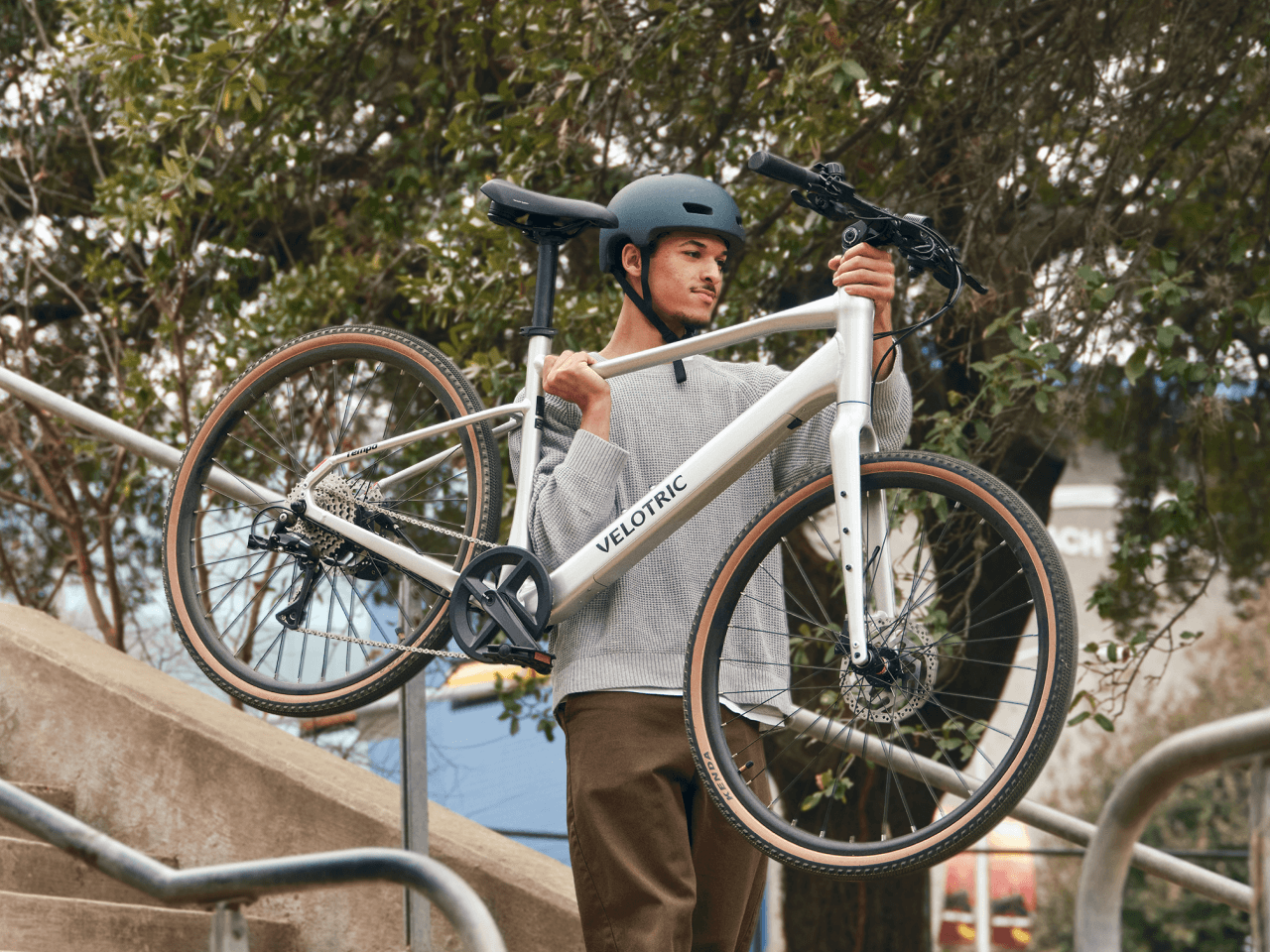
- Easier lifting. The bike weighs 39 lbs with the battery and 34 lbs without it, helping with storage and transport.
- Flexible pedal assistance. SensorSwap offers torque or cadence sensing, and the throttle is removable.
- Everyday range. Up to 60 miles of pedal-assist range under the manufacturer's test conditions. Actual range depends on terrain, rider weight, assistance level and conditions.
- Practical control. Shimano hydraulic disc brakes and integrated lighting support everyday riding.
The Tempo supports Class 1, Class 2 and Class 3 configurations. Confirm the actual configuration, label and route permission before riding. Class 3 street and highway use brings Tennessee's age, helmet and speedometer requirements, even if the same bike can also operate in a lower class.
Frequently asked questions
Are 750W ebikes legal in Tennessee?
Tennessee's ebike definition says less than 750 watts. Do not assume that a motor advertised as exactly 750W meets that wording. Confirm the manufacturer's specifications and applicable vehicle classification before relying on bicycle access rules.
Is the minimum Class 3 rider age 14 or 16?
It is 16 for operating on streets and highways, effective July 1, 2026. The former age-14 rule appears in older summaries.
Do adults need helmets on Class 3 ebikes?
Yes. All Class 3 operators and passengers must wear a compliant helmet, regardless of age.
Can I ride an ebike on a sidewalk?
Only where the responsible authority has authorized bicycle use on that sidewalk and the electric motor is disabled. Ordinary road permission does not establish sidewalk permission.
Are ebikes allowed in the Smokies?
Current park guidance permits Class 1 and Class 2 on authorized bicycle routes, subject to closures and operating rules. Most hiking trails remain closed to bicycles.
Sources and legal notice
Reviewed November 5, 2026. This guide is informational and does not constitute legal advice. The 2026 enacted amendments should be read alongside the underlying code; older summaries may still show the former Class 3 age limit. Confirm local and land-manager requirements before riding.
- Tennessee General Assembly, SB 1782 / Public Chapter 651 (2026)
- Adopted Senate Amendment 1: access authority and Class 3 age
- Adopted Senate Amendment 2: Class 3 path and trail provisions
- TDOT bicycle laws and underlying ebike provisions; read with the 2026 amendments
- Tennessee state forest rules
- TWRA wildlife management area rules
- Great Smoky Mountains National Park bicycling guidance
- Great Smoky Mountains National Park superintendent's compendium