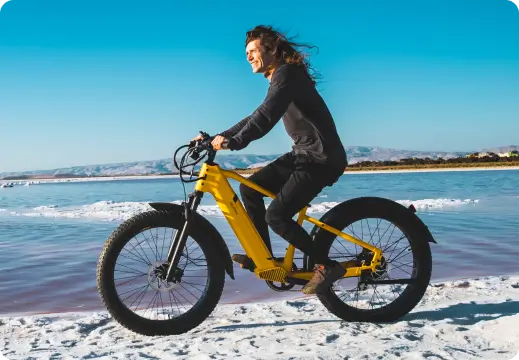




The motor is the single most defining part of an ebike. It sets the ceiling on how fast you accelerate, how confidently you climb, how much weight you can carry, and how far a charge will take you.
But with 350W, 500W, 750W, and even higher-powered motors crowding the market, "bigger number, better bike" has become the default assumption. Is it really that simple, though?
This guide breaks down what 750W really means, where the number falls short, and how to evaluate a 750W ebike as a complete system rather than a single spec.
What Does 750W Mean on an Ebike?
A watt measures power — the rate at which energy is delivered. On an ebike, the wattage rating describes how much power the motor puts out under a defined set of conditions, expressed through a simple relationship:
A system running at roughly 48 volts and 15 amps is drawing about 720 watts of electrical power. What actually reaches the wheel is somewhat less, since the motor and drivetrain lose a portion of that energy as heat.

In practice, a 750W motor gives you more headroom than a lower-powered hub drive — for accelerating hard, climbing, pushing through a headwind, or carrying extra weight.
*What it doesn't do is guarantee any particular result on its own; the number describes available power, not performance.
Rated Power vs. Peak Power
Beyond the standard motor wattage, you'll often see a "peak power" figure listed too. What does that actually mean?
- Rated or Nominal Power: Rated power is what the system is built to sustain during normal riding. An ebike marketed with a 750W rated motor is engineered around that output for everyday use — not just for a burst, but continuously.
- Peak Power: Peak power is the higher output the motor can produce briefly, typically during hard acceleration or a steep pitch. It depends on the controller, battery, software, and how well the system manages heat.
Peak numbers make for eye-catching marketing, but they aren't something a motor can hold indefinitely. If a listing only advertises a large peak figure without also stating rated power, torque, and battery specs, there isn't enough information to compare it meaningfully against another bike.
| Specification | What It Describes | Why It Matters |
|---|---|---|
| Rated power | Normal sustained motor power class | The most reliable figure for comparing motor capability and checking local legal definitions |
| Peak power | Short-duration maximum output | Shapes bursts of acceleration and short, demanding climbs |
| Torque | Rotational force, measured in newton-meters | Drives how a bike starts, climbs, and handles a load |
| Battery capacity | Stored energy, measured in watt-hours | Sets the realistic ceiling on range |
Watts vs. Torque vs. Speed
Watts, torque, and speed sound like they should move together, but each describes something distinct.
- Watts measure how quickly the motor can do work.
- Torque measures how strongly it can turn the wheel or drivetrain.
- Speed is the outcome of both, filtered through gearing, wheel size, load, terrain, wind resistance, and whatever legal speed cap the bike is tuned to.

A lower-wattage motor with strong torque can still feel more powerful off the line or on a climb than a higher-wattage motor that's tuned conservatively.
Torque numbers also need context. A hub motor applies force directly to the wheel and a mid-drive motor routes power through the bike's own gears. Wheel diameter and gear ratio then determine how much of that torque actually reaches the road.
350W vs. 500W vs. 750W Ebikes
Choosing a motor rating is really choosing a use case, not chasing a performance ceiling. A well-engineered 500W mid-drive can out-climb a mediocre 750W hub motor simply by working through the bike's own gears. A light 350W commuter can feel quicker and more efficient on flat pavement than a heavy 750W fat tire bike carrying far more mass.
The rating is a starting point for comparison, not a verdict. For a deeper side-by-side comparison, see our 500W vs. 750W ebike guide.
| Motor Rating | Typical Strengths | Common Tradeoffs |
|---|---|---|
| 350W | Lightweight city riding, flatter routes, a ride feel closer to a traditional bicycle | Less reserve power for steep hills, heavy cargo, or strong headwinds |
| 500W | General commuting and rolling terrain, a balance of power and weight | Real-world performance swings widely between hub-drive and mid-drive builds |
| 750W | Mixed riding, stronger acceleration, frequent hills, cargo, and all-terrain use | Usually paired with a heavier bike, and may run into more local access restrictions |
What a 750W Motor Changes in Real-World Riding
1. Faster, more confident starts
The extra power is most obvious from a standstill — pulling away at an intersection, merging into traffic, or setting off with a loaded pannier.
2. Better support on hills
Climbing is where a motor works hardest. A 750W system generally has more to give on an incline.
3. Better support for cargo and heavier loads
More weight means more energy needed to accelerate and climb, which is exactly why cargo and utility ebikes lean on 750W motors.
4. More versatility across different rides

Most riders don't stick to one predictable route. A single week might mix city streets, a hill, a headwind, a gravel shortcut, or a weekend trail. A well-tuned 750W system carries enough reserve power to handle that range of conditions without needing a bike built around one narrow use case.
What Else Should You Know About a 750W Ebike?
Motor wattage is only one part of an ebike's performance. To understand how a 750W ebike will actually accelerate, climb, and use energy, you also need to consider its battery, controller, motor design, and overall system efficiency.
1. Battery and Controller
The battery supplies energy to the motor, while the controller determines how much current reaches it. Most 750W ebikes use a 48V electrical system, but voltage alone does not determine performance. The controller must allow enough current, and the battery must be able to deliver it without a significant voltage drop under load.
Battery capacity is measured in watt-hours:
Watt-hours (Wh) = Volts (V) × Amp-hours (Ah)
For example, a 48V, 15.2Ah battery stores approximately 730Wh. Watt-hours provide a more useful battery comparison than amp-hours alone because they account for both voltage and capacity.

The battery management system also monitors voltage, current, and temperature. It may limit or interrupt power when the battery moves outside its safe operating range. This is another reason a large motor rating does not translate into unlimited output.
Power and Riding Range
A 750W motor doesn't constantly consume 750 watts. The rating describes the power available from the system, while actual energy use changes with assist level, throttle use, speed, hills, wind, tire pressure, and total rider and cargo weight.
Using maximum assistance frequently will consume the battery more quickly. Riding smoothly in a moderate assist mode can produce considerably more range. Motor wattage alone therefore tells you very little about riding distance—battery capacity, system efficiency, and riding style are more important.
Learn more in our complete electric bike battery guide.
Hub Motor vs. Mid-Drive Motor
Most consumer 750W ebikes use rear-hub motors, which are built into the wheel and operate independently of the chain and cassette. This generally makes them simpler to maintain and well suited to commuting, utility riding, and fat tire ebikes.

A mid-drive motor sends power through the bike's chain and gears. Downshifting allows it to use a lower gear when climbing, which can improve efficiency and control. That is why a well-designed 500W mid-drive may outperform some 750W hub motors on long or steep hills despite having a lower rated wattage.
For a detailed comparison, read our hub motor vs. mid-drive ebike guide.
How 750W Power Is Tuned for Different Ebikes
The same 750W rating can be tuned toward very different goals. These three Velotric models make that clear.
Daily Commuting: Velotric Discover 3

The Velotric Discover 3 commuter ebike pairs its 750W rear-hub motor with up to 1,100W of peak power and 75Nm of torque, tuned around city acceleration, everyday hills, and comfort — not maximum off-road output.
All-Terrain Riding: Velotric Nomad 2X

The Velotric Nomad 2X full-suspension fat tire ebike takes that same 750W rating up to 1,400W of peak output and 105Nm of torque. Paired with 26×4.0-inch tires, a 120mm air fork, and 80mm of rear-wheel travel, the whole system is built to work together across broken pavement, gravel, and dirt roads.
Are 750W Ebikes Legal?
A 750W ebike is legal across much of the United States, but wattage is only one piece of the rule. States and local agencies also regulate assisted speed, throttle operation, ebike class, rider age, helmet requirements, and access to bike paths and trails.
- New York: State law defines an electric bicycle as having a motor rated at less than 750W — meaning a bike rated at exactly 750W can fall outside that definition. Class 3 ebikes are also restricted to New York City under the state framework.
- Massachusetts: The state definition allows motors rated at 750W or less, and recognizes Class 1 and Class 2 ebikes. A 28 mph Class 3 configuration may not be treated the same way as a standard electric bicycle.
- California: A motor rated at 750W or less generally fits the state's ebike definition, but assisted speed and class still apply, and local agencies can still restrict access on specific paths and trails.
Changing a bike's class or speed settings doesn't override local law. Before buying or riding, check the rules for your state and for the specific roads, paths, and trails you plan to use. Start with our regularly updated U.S. electric bike laws by state guide.
Frequently Asked Questions About 750W Ebikes
Is 750W powerful for an electric bike?
Yes. For most consumer ebikes, 750W provides strong support for acceleration, hills, headwinds, cargo, and mixed terrain. How that translates into real performance still depends on torque, peak output, controller tuning, motor placement, battery capacity, gearing, wheel size, and total weight.
How fast can a 750W ebike go?
Wattage doesn't set a single top speed. Most ebikes are configured to stop assisting at 20 mph or 28 mph depending on their class and local regulations, while motor tuning, gearing, wheel size, load, and terrain shape the rest.
Can a 750W ebike climb steep hills?
A well-designed 750W system handles most hills well, though no wattage rating guarantees performance on every grade. Torque, motor type, gearing, total weight, traction, climb length, and motor temperature all factor in.
What battery size does a 750W ebike need?
There's no single required capacity. A larger battery generally means more potential range, while voltage and current capability determine how well it can support the motor. Compare watt-hours and the manufacturer's stated test conditions rather than capacity alone.
Is a 750W motor better than a 500W motor?
Not always. A 750W hub motor typically offers more reserve power than a comparable 500W hub motor, but a 500W mid-drive can use the bike's gears and may climb more efficiently. Bike weight, torque, tuning, and intended use matter just as much as the rated wattage.
Does a 750W ebike always use 750 watts?
No. Power draw shifts constantly with assist level, rider input, speed, terrain, and load. The 750W figure describes the motor's power class, not how much energy it's using at any given moment.
Are 750W ebikes street legal?
They're permitted in many places, though not everywhere and not in every configuration. Check state and local definitions, class rules, speed limits, throttle restrictions, and location-specific access before riding.
Final Takeaway
A 750W motor can offer a genuinely practical balance of everyday control and extra capability — especially if your riding involves hills, headwinds, cargo, rougher surfaces, or some mix of commuting and outdoor riding. But the wattage label is where the comparison should begin, not where it should end.
Rated and peak power, torque, battery watt-hours, controller behavior, motor placement, sensors, brakes, tires, payload limits, and local regulations all work together as one system. That system, not the number on the spec sheet, is what determines whether a 750W ebike actually feels smooth, capable, efficient, and right for how you ride.
Ready to compare specific options? Explore our guide to the best 750W electric bikes for different types of riding.