




Cargo ebikes have quietly gone from niche to everywhere. As cities get more crowded, more people are ditching cars in favor of something cheaper, faster, and way more fun — whether it's commuting to work, dropping kids off at school, hauling groceries, or running a small delivery operation.
That's where these two come in. The Velotric GoMad is a value-packed powerhouse that leans hard into motor output, cargo capacity, and tech. The Aventon Abound SR is a more refined daily rider — polished, comfortable, and backed by a brand with serious after-sales support. Both aim to replace your car for short trips. They just go about it very differently.
Comparison table: every spec, side by side
| Spec | Velotric GoMad — $1,999 | Aventon Abound SR — $1,899 |
|---|---|---|
| Frameset | ||
| User height | 5'0" – 6'3" | 4'11" – 6'3" |
| Frame | Triple-butted aluminum alloy | 6061 aluminum, diecast front triangle |
| Fork | RST hydraulic, 100mm travel, lockout, 36mm inner tube | Threaded quill stem, 50mm travel, adjustable lockout |
| Electronics | ||
| Motor | 48V 750W (1,300W peak), 85Nm | Shengyi 36V 750W hub (1,188W peak) |
| Battery | 48V 16.7Ah (801.6Wh) IPX7 | 36V 20Ah (733Wh) IPX6 |
| Cell | Samsung/LG 21700, UL2580 | LG 21700, UL2580 |
| Charger | 48V 3A fast charger | Aventon 4A 42V |
| Pedal sensor | Dual torque + cadence | Double-sided BB torque sensor |
| Display | 3.5" full color, Bluetooth, NFC, adjustable angle | Aventon BC147 |
| USB port | USB Type-C phone charge | — |
| Throttle | Trigger-control, removable | Aventon LH handlebar mounted |
| Pedal assist | 5 modes + Stealth Mode/Ride Tuning | 3 levels with Ride Tune customization |
| Walk mode | 2.9 MPH / Walk & Hold | Hold mode |
| Front light | 500LM integrated LED, adjustable angle | — |
| Rear light | Braking indicator + turn signal, rack-integrated | — |
| OTA | App OTA updates | Display-based updates |
| Anti-theft | Apple Find My + Google Find Hub + NFC card unlock | E-lock kickstand + startup password + geofencing |
| Speed & Range | ||
| Max speed (default) | 20 MPH | 20 MPH |
| Max speed (unlocked) | Up to 28 MPH | Up to 25 MPH |
| Ebike class | Class 1 / 2 / 3 | Class 1 / 2 |
| Range | 75 miles | 60 miles |
| Drivetrain | ||
| Chainring | 52T narrow-wide | 52T |
| Crankset | Aluminum alloy, 165mm | 3pc, 165mm crank arm |
| Cassette | 8-speed, 11–34T | Shimano CS-HG200-8, 12–32T |
| Rear derailleur | Shimano 8-speed | Shimano Altus RD-M310 |
| Shift lever | Shimano 8-speed | Shimano SL-M315-8R |
| Chain | KMC 8-speed | 122-link 8-speed |
| Brake & Wheel | ||
| Brake | Tektro hydraulic disc | Tektro HD-E3520 hydraulic disc |
| Rotors | 203mm front / 180mm rear | 180mm 6-bolt (both) |
| Tire | KENDA 20×4.0" puncture resistant | 20×3.0 urban, reflective sidewalls |
| Cockpit & Supports | ||
| Handlebar | BMX style, 31.8mm, 700mm wide | Aventon LH handlebar |
| Grips | Ergonomic, lockable | Lock-on ergonomic |
| Stem | Quill, 31.8mm, 30mm, 140mm adj. | Quill, 31.8mm, 40mm, 140mm adj. |
| Saddle | Velotric comfort ergonomic | Aventon by Selle Royal |
| Seatpost | Aluminum alloy Ø30.9mm | 30.9mm suspension seatpost, 50mm travel |
| Fenders | Plastic, full coverage F+R | Plastic, full coverage F+R |
| Rear rack | MIK HD compatible, frame-integrated | Included (standard) |
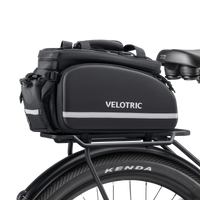
| Rear rack bag | Included as standard | Not included |
| Kickstand | Aluminum alloy, rear mount | E-lock kickstand |
| Pedals | Plastic | 9/16" composite platform |
| Weight & Load | ||
| Bike weight | 77 lbs (66.5 lbs w/o battery) | 80 lbs |
| Rear rack capacity | 176 lbs | 143 lbs |
| Max load | 500 lbs | 440 lbs |
| Certification | ||
| UL certification | UL2849 & UL2271 | UL2849 & UL2271 |
| Water resistance | IPX6 frame / IPX7 battery | Bike IPX5 / Components IPX6 |
| ISO standard | ISO 4210 | — |
Motor & power: who wins on a hill with a full load?

The GoMad's 48V architecture delivers noticeably punchier acceleration and stronger sustained climbing power. If you live in a hilly city — Seattle, San Francisco, Pittsburgh — or regularly haul significant weight, that extra torque means the difference between confident starts from a stop and that dreaded "lag and lurch" feeling under load.
The Abound SR's 36V system is entirely competent for flat urban commuting and light cargo work. Most everyday riders won't feel shortchanged. But push it harder — steeper grades, heavier loads, longer distances — and the GoMad's headroom becomes tangible.
If your route has real hills or your loads are consistently heavy, the GoMad's power system is meaningfully better. For flat city riding with moderate cargo, both are fine.
Cargo capacity: the number that defines a cargo ebike

The GoMad supports 33 more pounds on the rack alone — the difference between comfortably hauling two full bags of groceries and having to ration your load. The 500 lb total capacity also means larger riders can carry more cargo without approaching the limit.
The GoMad's MIK HD compatibility is worth calling out specifically. MIK (Mounting Is Key) is a standardized rack system with a wide ecosystem of compatible panniers, cargo boxes, and child seats that click on and off in seconds — making the bike genuinely more versatile as your needs evolve, rather than locking you into proprietary accessories.
The included rear rack bag is a small but meaningful bonus — that's $40–80 of real-world value right out of the box.
If you're buying a cargo ebike to carry things, the GoMad is the more capable tool. The Abound SR's capacity is respectable, but it's not in the same tier.
Frame & suspension: what does that extra $100 actually buy you?

Suspension on a cargo bike isn't a luxury — it's a control and fatigue issue. When you're carrying groceries, a child seat, or delivery cargo over brick streets, potholes, and road seams, an unsuspended front end transmits every impact directly to your wrists, shoulders, and the cargo itself. Over a 45-minute commute, that adds up fast.

The GoMad's lockout function is also genuinely useful: engage it on smooth pavement or while climbing to eliminate fork bob and improve pedaling efficiency. It's the kind of feature that sounds like a detail until you've ridden both ways.
The Abound SR partially compensates with its 50mm suspension seatpost, which takes the edge off rear-end chop. It's a thoughtful touch — but it doesn't replace front suspension for handling and control.
For rough urban surfaces or any load-carrying scenario, the GoMad's suspension fork is a meaningful real-world advantage. The Abound SR is smoother than it looks on paper thanks to the seatpost, but it's not the same.
Speed & range: how far and how fast do you actually need to go?

For most urban cargo riders, 60 miles is more than enough — a typical grocery run or school drop-off won't test range limits. Where the gap matters is for riders doing multi-stop delivery routes, long commutes with return trips, or anyone regularly pushing past 30 miles per day.
The speed ceiling difference is similarly context-dependent. If you're using protected bike paths that allow higher speeds, or doing delivery work where time efficiency matters, the GoMad's Class 3 ceiling gives you options the Abound SR simply doesn't have.
Range and top speed favor the GoMad, but only matter if your actual use case demands them. Be honest about your daily mileage before letting this category drive your decision.
Electronics & smart features: the biggest gap between these two bikes

In practice, the GoMad's dual sensor setup makes pedal assist feel more like riding a real bike — power delivery is immediate and proportional. The color display is genuinely easier to read in full sunlight. And Apple Find My integration is more practically useful than most dedicated GPS trackers: it works silently, needs no subscription, and leverages the world's largest tracking network.
The Abound SR's geofencing and kickstand e-lock are clever — but the overall tech package feels like the previous generation compared to everything the GoMad ships with.
If smart features and ride feel matter to you, the GoMad is in a different league. The Abound SR is functional but not exceptional here.
Drivetrain & brakes: closer than you'd think

Both bikes run Shimano 8-speed drivetrains with hydraulic disc brakes — a genuinely good outcome at this price point. Hydraulic discs on a cargo bike are non-negotiable: consistent stopping power regardless of weather or load weight, and both deliver here.
The GoMad's larger 203mm front rotors offer marginally stronger bite and better heat dissipation under heavy braking. It's not dramatic — but on a loaded bike descending a steep hill, rotor size matters more than it does on a lightweight road bike. The Abound SR's Shimano Altus groupset is proven and serviceable. Both bikes need the same basic maintenance schedule.
This category is essentially a tie with a small GoMad braking edge. Don't let drivetrain specs be a deciding factor — both are solid.
Two great bikes.
Two different riders.
On specs alone, the GoMad wins more categories than it loses. But specs aren't the whole story. Here's how to know which one is actually right for you.
You're serious about replacing your car. The GoMad is built for riders who need a genuine car alternative — not just a bike with a rack on it.
- Costco runs, Farmers Market hauls, bulk shopping
- School pickups with a loaded rear rack
- Last-mile delivery or frequent multi-stop errands
- Hilly terrain with heavy loads
- Riders who want maximum tech and the highest performance ceiling
You want a capable, comfortable ebike that handles everyday cargo well — without being engineered for more than you'll ever use.
- Regular grocery runs and everyday errands
- Daily commuting with a bag or light cargo
- Riders who prioritize comfort over max capacity
- Anyone who values brand support and a mature app ecosystem
- Flat-to-rolling terrain, moderate daily mileage
Velotric GoMad
The Aventon Abound SR is a perfectly good ebike. For someone who just wants to run the occasional errand or commute with a light bag, it does the job without complaint. But if you're reading a cargo ebike comparison, you're probably not "just an occasional errand" kind of rider.
The Velotric GoMad is built for people who actually mean it. More power when you're loaded up and facing a hill. More rack capacity when you need to haul real weight. Better suspension for the roads that actually exist in your city. Smarter tech that earns its place every single ride. And a Class 3 top speed that keeps you moving when time matters.
At $1,999, the GoMad is asking you to pay for what you actually get. A utility ebike that was designed around the hardest version of the job, so it handles everything easier than that with room to spare. Most people buy a cargo ebike once. Buy the one you won't outgrow.