Sales


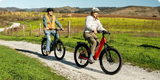






What makes an electric bicycle different from a traditional bike? The motor. An e-bike’s electric motor adds power to your pedaling, so you can ride farther, climb hills with less effort and handle rougher terrain. That is why e-bikes have so many unique benefits.
But shopping for one means decoding a lot of jargon: V, Ah, Wh, Nm, RPM, W, PAS, mid-drive, hub, Class 1, 2 or 3. Motor technology also moved quickly in 2026. This guide explains how e-bike motors work, what each spec really means, how the main motor types compare, and how to choose the right one for how you ride.
- How Electric Bike Motors Work: Volts, Amp Hours and Watt Hours
- Torque, Speed and Power: What Nm, RPM and Watts Mean
- Throttle vs. Pedal Assist, Torque Sensors vs. Cadence Sensors
- Types of Electric Bike Motors
- Rated Power vs. Peak Power
- Electric Bike Classes, Laws and Safety Certifications
- Best E-Bike Motor Manufacturers in 2026
- Which Motor Is Best for You?
- Velotric Motors at a Glance
- FAQs
How Electric Bike Motors Work: Volts, Amp Hours and Watt Hours
The motor is powered by the bike’s battery, so battery terms come first.
Volts (V) measure electrical “pressure,” and amp hours (Ah) measure how much charge the battery holds. Multiply them and you get the number that matters most for range: watt hours (Wh), the battery’s total energy. Think of Wh as the size of the bike’s fuel tank.
Wh = V × Ah
- The Velotric Discover 3: 48V × 15.2Ah ≈ 730Wh, with up to 80 miles of claimed range.
- The Velotric Nomad 2X: 48V × 16.7Ah ≈ 801.6Wh, with up to 75 miles of claimed range.
The Nomad 2X has the bigger battery but a shorter range. The reason is weight and rolling resistance: a sturdier frame, full suspension and fat tires use more energy per mile. Range always depends on the bike, the rider, the terrain and the assist level.
Why voltage still matters
Electrical power is volts multiplied by amps (W = V × A). A higher-voltage system can deliver the same power with less current, which means less heat and better efficiency. Shimano’s new EP810 is a good example: it moved from the 36V system used by the EP801 to 43.2V while raising peak power and torque.

Voltage is not the same as horsepower, though. Volts tell you about the electrical system. Watts tell you how much power the motor can actually produce.
Torque, Speed and Power: What Nm, RPM and Watts Mean
Torque (Nm)
Torque is rotational force, measured in Newton meters (Nm). It is what gets you moving from a stop and up a steep hill. On a mid-drive, the motor turns the crank; on a hub motor, it turns the wheel. In both cases, more torque means stronger acceleration and easier climbing.
Torque numbers are usually peak figures, and brands don't always measure them the same way, so use them for comparison rather than as exact promises. A mid-drive’s torque is also multiplied by the bike’s gears, which is why mid-drives climb so well.
Speed (RPM)
RPM, or revolutions per minute, is how fast the motor turns. Torque tells you how hard it twists; RPM tells you how fast.
Power (W)
Power is torque multiplied by rotational speed. In practical units:
Power (W) ≈ Torque (Nm) × RPM ÷ 9.55
For example, a motor producing 100 Nm at 60 RPM delivers roughly 628W at that moment. (The divisor comes from converting RPM into radians per second: 2π ÷ 60 ≈ 0.105.) A motor’s watt rating depends on both how hard it twists and how fast it spins, and that is why watts and torque have to be read together.
Throttle vs. Pedal Assist, Torque Sensors vs. Cadence Sensors
Throttle vs. pedal assist (PAS)
A throttle, usually a thumb lever or twist grip, engages the motor without pedaling. Pedal assist (PAS) adds motor power only while you pedal, usually at several selectable levels. Many bikes, including Velotric’s Discover and Nomad models, offer both, so you can pedal with assistance or cruise on the throttle.
Torque sensor vs. cadence sensor
This is one of the biggest factors in how an e-bike feels, and spec sheets often skip it.
- Cadence sensor: detects that the pedals are turning and delivers a preset amount of assist. It feels simple and steady, and it is good for low-effort cruising.
- Torque sensor: measures how hard you press on the pedals and scales the assist to match. It feels more natural and responsive, and it tends to be more efficient.
Some bikes let you choose. Velotric’s SensorSwap™ switches between the two modes, so you can pick a natural torque-sensing feel or relaxed cadence-based cruising.
Types of Electric Bike Motors
Motors differ in where they sit on the bike and how they transfer power. For a deeper comparison, see our mid-drive vs. hub motor guide.

Mid-drive motors
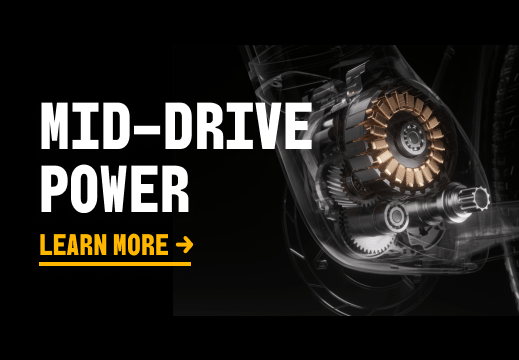
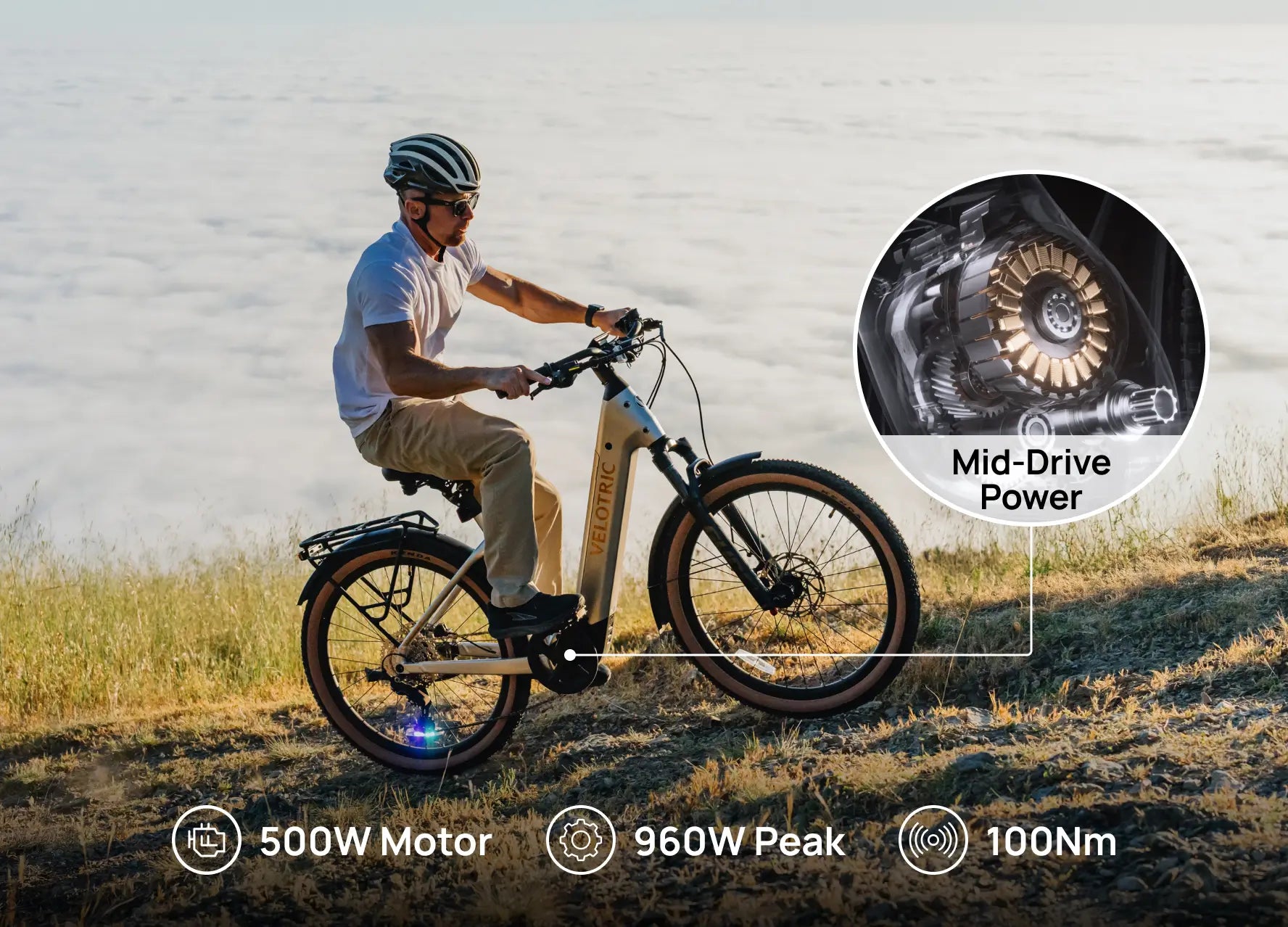
A mid-drive motor sits at the bike’s bottom bracket, between the pedals, and drives the crank. Power then flows through the chain and the bike’s gears, so the motor’s torque is multiplied just like your own pedaling.
- Pros: excellent hill climbing, a natural pedaling feel, efficient power use, and a low, central weight balance that helps handling.
- Cons: higher cost, more complex servicing, and more wear on the chain and cassette. If the chain breaks, the motor cannot move the bike.
Velotric’s first mid-drive, the Discover M, uses its in-house VeloCore™ system: 500W nominal, 960W peak and 100 Nm of torque.
Geared hub motors
A geared hub motor sits inside the wheel hub, usually the rear one. A small, fast-spinning motor turns the wheel through internal planetary gears, which reduce speed and multiply torque. A clutch lets the wheel freewheel with little drag when the motor is off.
- Pros: compact, lightweight, affordable, strong torque for the motor’s size, and little drag when you pedal without assist.
- Cons: less efficient on long, steep climbs than a mid-drive, and the internal gears can wear over time.
This is the most common design on commuter and cruiser e-bikes, including the Velotric Discover 3, Tempo and Nomad 2X.
Direct-drive hub motors
A direct-drive hub motor has no gears. The motor itself is the hub, spinning around a fixed axle.
- Pros: simple, durable, quiet, and capable of high sustained power. Some designs can also recover energy through regenerative braking.
- Cons: heavy and bulky. Because the motor never disengages, it can add drag when you pedal without power, and the weight over the rear wheel can affect handling.
Direct-drive motors are less common on today’s commuter e-bikes, as geared hubs have largely replaced them.
| Feature | Mid-Drive | Geared Hub | Direct-Drive Hub |
|---|---|---|---|
| Hill climbing | Excellent (uses bike gears) | Good | Moderate |
| Ride feel | Most natural | Smooth, “motor in the wheel” | Smooth, can feel heavy |
| Weight balance | Low and central | Rear-biased | Rear-biased, heaviest |
| Drivetrain wear | Higher | Normal | Normal |
| Cost | Highest | Lowest to mid | Low to mid |
Rated Power vs. Peak Power
Rated (nominal) power is the power a motor can sustain without overheating. Peak power is the short burst it can deliver for hills or fast starts. Brands often advertise both, such as 750W / 1100W. A higher wattage means more available power, but that does not automatically make a bike better.
Under federal law, a “low-speed electric bicycle” has working pedals, a motor under 750W and a motor-only top speed under 20 mph. States then set their own rules for where and how you can ride. For more on wattage, see 500W vs. 750W e-bikes.
Why watts alone can mislead
Compare two current Velotric commuters:
- Discover 3: 750W rear hub (1100W peak), 75 Nm, 730Wh battery, up to 80 miles claimed.
- Discover M: 500W mid-drive (960W peak), 100 Nm, 801.6Wh battery, up to 95 miles claimed.
The Discover M has the lower wattage rating but more torque, because a mid-drive works through the bike’s gears. Its larger battery and more efficient drive also support the longer claimed range. A bigger watt number does not guarantee stronger climbing or longer range, so check torque, motor type and battery size together. Claimed ranges are best-case figures, and real-world results will be lower with heavy loads, hills, cold weather or high assist levels.
Electric Bike Classes, Laws and Safety Certifications
The three classes
Most U.S. states use the three-class system, which depends largely on how the motor assists and how fast it does so.
| Feature | Class 1 Ebike | Class 2 Ebike | Class 3 Ebike |
|---|---|---|---|
| Max Assist Speed | 20 mph (PAS only) | 20 mph (PAS + throttle) | 28 mph (PAS only) |
| Throttle | ❌ No | ✅ Yes | ❌ No (in most states) |
| Typical Minimum Age | Usually none | Usually none | Commonly 16 (varies by state) |
| Typical Use Case | Bike paths, urban commuting | All-around convenience | Fast commuting on roads |
- Class 1 bikes assist only while you pedal, up to 20 mph. They are the most widely accepted on bike paths and trails.
- Class 2 bikes also stop assisting at 20 mph but add a throttle that can move the bike without pedaling.
- Class 3 bikes assist up to 28 mph and are typically required to have a speedometer. They are often restricted from some bike paths, and many states set age or helmet requirements for them.
Some current bikes, including the Discover 3 and Discover M, let riders switch class settings. If yours does, set it to the class your local rules allow where you ride.
Class 1 EbikesLaws are changing fast
E-bike regulations changed a lot in 2026, and they vary widely from state to state. Tennessee raised its Class 3 minimum age from 14 to 16, Hawaii adopted the three-class system and raised its helmet age to under 18, and New Jersey overhauled its e-bike rules. California requires helmets for all Class 3 riders and for anyone under 18 on any e-bike.
Before you ride or buy, check your state and local rules. Our state-by-state e-bike laws guide is a good starting point.
Safety certifications now matter more than ever
Two standards are worth knowing:
- UL 2849 covers the e-bike’s whole electrical system: battery, charger, motor and controller working together.
- UL 2271 covers the battery pack itself.
Since January 1, 2026, California’s SB 1271 has required new e-bikes and e-bike batteries sold in the state to be tested by an accredited lab to a recognized standard such as UL 2849 (or EN 15194), with certification labeling. The U.S. Consumer Product Safety Commission’s warning about certain Rad Power Bikes batteries showed what can go wrong with battery safety. Wherever you live, look for a UL label on both the bike and the battery before you buy.
Best E-Bike Motor Manufacturers in 2026
Many e-bikes use motors from a handful of respected system makers, while others use in-house designs. A well-known motor brand usually means better software, better diagnostics and wider dealer support, which matters when something needs service.
Bosch
Bosch focuses on mid-drive systems. Its drive unit lineup includes the Active Line and Active Line Plus for commuting, the Performance Line and the lighter Performance Line SX (about 60 Nm) for sporty riding, the Cargo Line for hauling, and the Performance Line CX and CX-R for demanding trail use. The newer Performance Line PX targets touring and trekking.
In 2026, Bosch introduced a free “Performance Upgrade 2.0” through its eBike Flow app. It lets owners of CX and CX-R drive units raise torque up to 120 Nm, though the maximum depends on each bike manufacturer’s settings. Bosch systems are known for refined sensor-based assistance that tracks cadence, speed and pedal force, plus connected features such as app-based theft protection.
Shimano
Shimano remains one of the largest bicycle component makers in the world, and its mid-drive e-bike motors are widely used. The EP801 and EP6 deliver up to 85 Nm. In November 2026, Shimano unveiled the EP810, with up to 100 Nm and 750W peak power on a 43.2V system, a lighter body and new software features. Shimano’s city and trekking motors sit lower in the range and are aimed at commuter and touring bikes.
Yamaha
Yamaha sold its first power-assist bicycle back in 1993. Its current mid-drives include the PW-X3 (85 Nm) and the PWseries S2 (75 Nm), alongside city-oriented PWseries models. Its new PW-Link platform adds the PW-X4 (up to 100 Nm and 800W peak) and the compact PW-L1 light-assist unit.
Newer and in-house systems
The market is more crowded than it used to be. DJI’s Avinox drives are among several newer systems pushing past 100 Nm in e-mountain bikes, and some brands, including Velotric with its VeloCore mid-drive, build their own systems. In-house designs can deliver strong specs for the price. The trade-off is that service and parts depend on that one brand, so check warranty terms and parts availability before you buy.
Which Motor Is Best for You?
There is no single best motor. The right one depends on your terrain, load and budget. A well-supported motor from a reputable maker is a solid starting point, and then the rest comes down to how you ride.
| If you mostly… | Look for |
|---|---|
| Commute on flat or gently rolling roads | A 350–750W geared hub with a torque sensor and a UL-certified battery |
| Climb steep or long hills | A mid-drive, or a hub with high torque (75 Nm or more), plus a wide gear range |
| Want the most natural pedaling feel | A torque sensor, ideally on a mid-drive |
| Carry cargo, kids or heavy loads | High torque, a high payload rating and strong brakes |
| Ride sand, snow or off-road | High torque (100 Nm or more), fat tires and suspension |
| Need to maximize range | A large battery (Wh) paired with an efficient motor, rather than the highest wattage |
| Want light, easy handling | A lower-powered, lightweight system, such as the Velotric Tempo |
As a rule of thumb, a 500W-class motor is plenty for most city riding, while 750W-class systems make more sense for hills, cargo and mixed terrain. Whatever you choose, check the battery certification, the warranty and the availability of replacement parts.
Velotric Motors at a Glance
Velotric’s lineup covers each motor type discussed above. Specs below are manufacturer-claimed; please check each product page for the latest details.
| Model | Motor | Rated / Peak | Torque | Range |
|---|---|---|---|---|
| Tempo | Rear hub | 350W / 650W | 40 Nm | Up to 60 miles |
| Discover 3 | Rear hub | 750W / 1100W | 75 Nm | Up to 80 miles |
| Discover M | Mid-drive (VeloCore™) | 500W / 960W | 100 Nm | Up to 95 miles |
| Summit 2 | Rear hub | 750W / 1300W | 100 Nm | Up to 95 miles |
| Nomad 2X | Rear hub | 750W | 105 Nm | Up to 75 miles |
Velotric lists UL 2271 and UL 2849 certification on current models such as the Discover 3. Batteries carry an IPX7 waterproof rating, and frames are rated IPX6. Bikes are equipped with hydraulic disc brakes and multi-level pedal assist. Check each product page for the specifics of the model you are considering.
FAQs
What is the best motor for an electric bike?
It depends on how you ride. A mid-drive suits steep hills and a natural pedaling feel, while a geared hub offers good value for commuting and casual riding. Choose a reputable system or brand, then match torque, power and battery size to your terrain and load.
Is a mid-drive better than a hub motor?
For climbing and ride feel, usually yes, because a mid-drive uses the bike’s gears. But mid-drives cost more and wear the drivetrain faster. A good geared hub is quieter on the budget and plenty capable for most commuters.
Is torque or wattage more important?
For acceleration and climbing, torque tells you more. Wattage describes power, which combines torque and speed. Look at both, along with the motor type.
Is a 500W or 750W motor better?
Neither is universally better. A 500W system is often enough for city riding and can be very efficient, while 750W suits hills, cargo and mixed terrain. A 500W mid-drive can outclimb a 750W hub if its torque is higher.
Do I need a Class 3 e-bike?
Only if you want assisted speeds up to 28 mph on roads. Class 1 and 2 bikes are accepted in more places, and Class 3 comes with age and helmet rules in many states. Check your local laws first.
What certifications should an e-bike have?
Look for UL 2849 for the full electrical system and UL 2271 for the battery. California now requires certification for new e-bikes and batteries sold in the state, and uncertified batteries are a major fire-safety concern everywhere.