



Have you been told you should buy an eMTB? Maybe you watched a few YouTube reviews and every video seemed to feature someone launching off a rock drop or carving through a steep, technical descent. The message, intended or not, was clear that more capability equals a better ebike.
But here's a question worth sitting with before you spend $3,000 or more. When was the last time you actually rode a technical mountain trail?
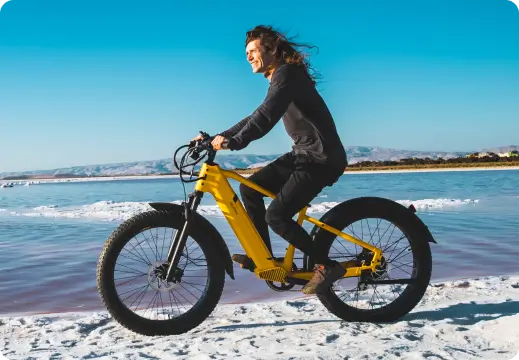
For most people, a typical week on two wheels looks something like this — a commute to work on city streets, a lunch ride through the park, a weekend route that mixes bike paths with the occasional gravel connector, maybe a gentle climb through some light woodland trails. And that’s exactly where the idea of a hybrid eBike comes in.
If you've ever felt that way, this guide is for you. Before you decide, it helps to understand what each type of bike is genuinely built for, and more importantly, who it's actually built for.
What an eMTB Is Really Designed For
An electric mountain bike (eMTB), is purpose-built for handling terrain that would stop most bikes in their tracks. That means steep, technical climbs with loose rock and exposed roots. Fast descents where the trail drops away beneath you. Jumps, drops, switchbacks, and the kind of riding where a wrong move has real consequences.
This is a serious tool for serious terrain. When used for what it's designed for, an eMTB is genuinely impressive. It absorbs impacts, maintains traction on unpredictable surfaces, and gives riders the confidence to push harder than they could on a standard mountain bike.

Key Design Features of an eMTB
Every design decision on an eMTB traces back to that one purpose.
- Full suspension systems (front fork + rear shock)
- Wide tires (usually 2.4–2.8 inches)
- High-torque mid-drive motors
- Aggressive, forward-leaning riding geometry
- Heavier-duty frame construction
- Total weight often between 23–30kg
These bikes are built for people who need high-impact absorption, who want aggressive handling on steep descents, and who are willing to manage the trade-offs that come with a bike designed for the extreme end of the spectrum.
The Trade-Offs Most Casual Riders Don't Consider
eMTBs are genuinely difficult to live with if trail riding isn't your primary use case. The weight is the most immediate issue. At 25–30kg, carrying one up a flight of stairs, loading it onto a car rack, or maneuvering it through a crowded bike lane requires real effort every single time.
On city streets, those wide knobby tires create noticeable rolling resistance. You're working harder, and the battery is draining faster, just to maintain normal commuting speed. Full suspension systems require regular servicing, and the components involved are more expensive to maintain and replace than simpler setups. And the price reflects all of that engineering: a capable eMTB typically starts well above $3,000.
For someone who rides gravel paths and park trails on weekends, that's a lot of trade-off for capability that rarely gets used.
What a Hybrid eBike Is Designed For
A hybrid eBike starts from a different premise entirely. Rather than optimizing for the most demanding terrain possible, it's designed around the way most people actually ride — a mix of city streets, bike paths, light gravel, park trails, and the occasional unpaved connector. Not extreme in either direction, but genuinely capable across all of it.

The goal is to handle everything a typical rider actually encounters, comfortably and efficiently, without carrying around capability they'll never need.
Key Design Characteristics of a Hybrid eBike
Most hybrid eBikes include:
- A semi-upright, comfortable riding posture
- Moderate tire width (typically 1.75–2.2 inches)
- Front suspension or rigid fork
- Lighter frame design
- Total weight usually between 18–24kg
- More efficient pedaling dynamics
Riders who switch from heavier bikes to hybrid eBikes tend to notice the difference quickly. The more upright riding position makes longer rides more comfortable and reduces strain on the wrists, neck, and lower back. And because the hybrid eBike isn't optimized for the extreme end of anything, it tends to do everything at a level that satisfies most riders without demanding much in return.
Learn more about Hybrid Ebikes
Hybrid eBike vs eMTB — Key Differences That Actually Matter
| Hybrid eBike | eMTB | |
|---|---|---|
| Weight | 18–24 kg | 23–30 kg |
| Tire Width | 1.75–2.2 in | 2.4–2.8 in |
| Suspension | Front fork (or rigid) | Full suspension |
| Riding Position | Upright / semi-upright | Aggressive / forward |
| Best Terrain | Pavement, gravel, light trails | Technical trails, steep descents |
| Rolling Efficiency | Higher | Lower |
| Maintenance | Lower complexity | Higher complexity |
| Typical Price | $1,500–$3,000 | $3,000–$6,000+ |
Weight & Handling
On a trail, the extra weight of an eMTB is manageable — momentum works in your favor, and the terrain demands the stability anyway. In a city, that same weight becomes a constant friction point. A hybrid eBike's lighter frame makes urban riding more fluid and less exhausting over time.
Tire & Rolling Efficiency
Wide, knobby tires are essential for grip on loose terrain. Hybrid eBike tires are designed to be efficient on pavement while still handling gravel and packed dirt without issue. For mixed-surface commuters, that balance matters every single ride.
Riding Position & Comfort
The forward-aggressive geometry of an eMTB puts weight over the front wheel, which helps with control on technical descents. Over a long commute, that position creates real fatigue. A hybrid eBike's more neutral geometry lets you ride longer and more comfortably.
Suspension & Maintenance
All seals, rear shock services and pivot bearings require periodic attention and add up in cost over time. A front-suspension or rigid hybrid eBike has fewer moving parts to service, which keeps ongoing maintenance simpler and more affordable.
Price vs Practical Value
An eMTB's price reflects the engineering required to handle extreme terrain. If that terrain is part of your regular riding, the investment makes sense. For most riders, a hybrid eBike delivers better practical value simply because it's optimized for the riding they actually do.
Learn more about Hybrid Ebikes
When a Hybrid eBike Is More Than Enough
Ride mostly on pavement: If the majority of your rides happen on city streets, bike lanes, and paved paths, you don't need the capability of an eMTB.
Occasionally ride gravel or park trails: Gravel paths, packed dirt, light forest roads, gentle slopes — a hybrid e-bike handles all of these without issue.
Value comfort over aggressive performance: If you're not chasing technical lines, not hitting jumps, and not descending steep trails at speed, the aggressive geometry and heavy build of an eMTB doesn't serve you.
Don't want a 30kg(67 lbs) eBike: A hybrid eBike that you can carry and manage more easily is a bike you'll actually use.
The question isn't whether an eMTB can do more. It's whether that extra capability is worth the daily trade-offs for your specific riding life.
Velotric Summit 2 - Your Good Hybrid eBike Option
If your riding looks like what we described, then the Velotric Summit 2 represents what a well-balanced hybrid eBike should be.

It’s not built as a full downhill machine. It’s built for real-life mixed riding. Here’s why it fits the hybrid profile so well:
-
Strong but Practical Power
The 750W inner rotor motor (100Nm torque, 1300W peak) delivers confident climbing support for urban hills and light off-road terrain . -
120mm RST Air Suspension Fork
Longer travel than most commuter-style bikes (which typically offer ~80mm), helping absorb uneven pavement and gravel while remaining efficient on city roads. -
Balanced Riding Geometry
A semi-upright posture with adjustable stem bridges the gap between aggressive trail bikes and relaxed cruisers. -
Long Practical Range
Up to 95 miles under ideal conditions, supporting daily commuting and weekend rides without constant charging. -
Ready for Everyday Use
Integrated fenders, lighting system (including turn signals and brake light), and 440 lb payload capacity make it practical beyond recreational use. -
Smart Adaptability
One-touch Class 1/2/3 switching, SensorSwap™ (torque/cadence modes), ride tuning options, and tracking support make it adaptable across different environments.

If your riding reality is 80% daily use, 20% exploration, Summit 2 is designed exactly for that balance.
Choose Based on Your Reality, Not the Label
Not every rider needs a full mountain eBike. For the majority of people riding a mix of city streets, bike paths, and occasional light trails, a hybrid eBike just do the job. It's lighter, more efficient, more comfortable over time, and easier to integrate into daily life.
The best eBike isn't the most capable one on paper. It's the one that fits the way you actually ride.